



Business goodwill: where does it belong?

Share this article



A recent tribunal decision reinforces the need to establish ownership before considering valuation or tax treatment.
Key Points
What is the issue?
The First-tier Tribunal in WWM (Harrogate) LLP v HMRC considered whether a founder retained personally owned goodwill after incorporating a business. It concluded that ownership depends on the legal and commercial arrangements, not the founder’s reputation or client relationships alone.
What does it mean to me?
Before advising on the transfer or valuation of goodwill, practitioners should establish who owns the asset and whether it is capable of being transferred. Accounts, valuations and commercial assumptions cannot substitute for evidence of ownership.
What can I take away?
When reviewing goodwill, trace ownership from the original business transfer through later restructurings and disposals. Ensure that contracts, regulatory arrangements, accounts and tax reporting consistently support the claimed ownership position before considering valuation.
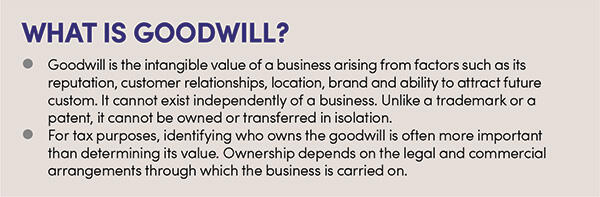
Many owner-managed businesses depend heavily on their founder. Clients may ask for that person by name, trust their judgement and remain loyal because of longstanding relationships. Some may even follow the founder elsewhere. It is therefore tempting to assume that the goodwill – the value inherent in a business because of its reputation, customer relationships and ability to attract future custom – belongs to the individual who brings in the work.
WWM (Harrogate) LLP v HMRC [2026] UKFTT 832 (TC) demonstrates why that assumption can be misleading. For capital gains purposes, goodwill is a business asset. As Lord Macnaghten observed in IRC v Muller & Co’s Margarine Ltd [1901] AC 217, it is the ‘attractive force which brings in custom’. However, goodwill cannot exist independently of the business to which it is attached. Reputation, relationships and personal skill may create value, but ownership depends on the legal and commercial structure through which that value is utilised.
This distinction was central to WWM. The question was not whether Mr Walters was central to the financial advisory practice, but whether, after incorporating the business, he retained or created a separate asset that he could later transfer to a limited liability partnership.
The tribunal answered no.
Ownership before valuation
Goodwill disputes often begin with arguments about valuation, before asking the more fundamental question of who owns the goodwill.
Advisers may focus on maintainable profits, fee multiples, client retention or the proportion attributable to the founder’s personality. However, those issues arise only after answering a more fundamental question: what goodwill exists and who owns it?
The analysis should proceed in the following order:
- Identify the business in which the goodwill has been created.
- Determine the legal and commercial rights that underpin its value.
- Establish who owns or controls those rights.
- Decide whether an identifiable asset has been transferred.
- Value that asset and apply the appropriate tax treatment.
In WWM LLP, the £860,662 valuation would be relevant only if the LLP could first establish that Mr Walters owned personal goodwill capable of transfer. As the LLP failed to prove the existence and ownership of such an asset, the tribunal did not need to consider whether the valuation was correct.
The business history
Mr Walters began trading as a sole financial adviser in 2006, initially serving 12 to 15 clients who had followed him from his previous employer. He then acquired a client book via St James’s Place (SJP) and expanded the practice, building a strong reputation that helped to attract and retain clients.
In 2008, Mr Walters incorporated the business as Walters Wealth Management Ltd (WWM Ltd), transferring the entire trade and its assets, including goodwill valued at £450,000. He reported the disposal for capital gains tax purposes. The company recognised the goodwill in its accounts, and the sole trade ceased. Mr Walters then continued as a director and employee of WWM Ltd, which became SJP’s appointed representative. Mr Walters did not have a personal registration with the FCA.
In 2014, Mr Walters and WWM Ltd formed WWM (Harrogate) LLP. A valuation placed the total goodwill at £1,075,827, of which 80% (£860,662) was attributed to Mr Walters. The LLP’s accounts recorded £860,662 as an intangible asset and credited the amount to his capital account, on the basis that he had contributed personally owned goodwill.
Why the ownership claim failed
The 2014 treatment credited £860,662 to Mr Walters’ capital account. It was intended to enable the LLP to make tax-free loan repayments to him, but it depended on the LLP having genuinely acquired an asset from him.
The missing link in the chain
The key question was therefore how the goodwill transferred to WWM Ltd in 2008 could have become Mr Walters’ personal asset by 2014. There was no agreement, retained right or intervening transaction to explain the change.
The evidence did not identify:
- any reservation of personal goodwill when the business was incorporated;
- any agreement that the clients belonged to Mr Walters rather than WWM Ltd;
- any transfer of goodwill back from the company to him;
- any arrangement allowing him to leave and advise the clients independently;
- any contemporaneous instrument transferring an identified asset from him to the LLP; or
- any coherent explanation of what the alleged personal goodwill comprised.
The LLP therefore had to prove that Mr Walters personally owned goodwill capable of transfer, but it failed to do so. The valuation and accounts recorded the transaction on that basis. However, neither established that he owned a transferable asset or possessed rights capable of being transferred to the LLP.
The LLP nevertheless argued that goodwill could remain personally owned after incorporation. In support of that argument, it relied in part on Smith and Corbett v HMRC [2023] UKFTT 912 (TC). In that case, the tribunal first concluded from the GAAP-compliant accounts that the company did not own the disputed goodwill and therefore could not have distributed it to the taxpayers. Although that finding was sufficient to decide the appeal, the tribunal also considered the nature and ownership of the goodwill as an alternative basis for its decision.
That alternative finding turned on the particular facts. Mr Smith and Mr Corbett were personally FCA-registered, and the tribunal found that their personal reputations and client relationships were not assets of the company. They were also entitled to continue advising those clients if they left, subject to their clients’ choice to follow them. Mr Walters’ position was materially different. He had transferred his entire business to WWM Ltd, was not personally FCA-registered, and could not advise the clients independently.
Evidence supporting company ownership
The tribunal’s conclusion was also supported by the way the advisory business actually operated. WWM Ltd contracted with clients, received advisory income, and operated as SJP’s appointed representative. The LLP had no clients, was neither FCA-authorised nor an appointed representative, and received only management fees from WWM Ltd.
The regulatory status alone was not conclusive. However, taken with the contractual and financial arrangements, it supported the tribunal’s conclusion that WWM Ltd carried on the advisory business and was the entity able to use the client relationships to generate income.
The 2021 sale agreement provided further evidence of that ownership. The signed but undated agreement showed WWM Ltd, rather than Mr Walters or the LLP, selling part of the business to Marshall Wealth Management Ltd. The assets included goodwill, the client list and the right to deal with the transferred clients. WWM Ltd also warranted that it could transfer full legal and beneficial ownership without the consent of any other parties. The LLP was neither a party to the agreement nor identified as owning any goodwill. This agreement therefore reflected the ownership position adopted in a third-party transaction. WWM Ltd presented itself as the owner entitled to transfer the goodwill and related assets. This was difficult to reconcile with the 2014 treatment, which attributed personal goodwill to Mr Walters.
The tax reporting created a further inconsistency. Mr Walters’ personal returns for the years ended 5 April 2015, 5 April 2016 and 5 April 2020 reported gains described as goodwill or as part of the sale of a business. Although Mr Walters and his accountant suggested that the transactions reflected disposals by both WWM Ltd and the LLP, the LLP reported no matching chargeable disposals, and the wider records did not support that division of ownership.
The tribunal’s conclusion
The First-tier Tribunal dismissed the LLP’s appeal in a decision dated 4 June 2026, following a hearing on 16 and 17 April 2026. It upheld HMRC’s closure notices dated 2 October 2024, which concerned the partnership returns for the tax years ended 5 April 2021 and 5 April 2022. Those notices required the written-down values of the goodwill, £365,782 and £279,716 respectively, to be removed from the LLP’s ‘other fixed assets’ and from Mr Walters’ capital account.
The tribunal accepted that personal goodwill could belong to someone other than the entity carrying on the business. However, that was not the position here. Mr Walters had transferred his sole trade and its goodwill to WWM Ltd. Any goodwill arising from his subsequent work for the company belonged to WWM Ltd, while his personal client relationships did not constitute a separate transferable asset. Accordingly, he had no goodwill to contribute to the LLP, and the £860,662 accounting entry did not represent capital he had introduced.
Practical implications for advisers
The decision has wider relevance beyond financial advisory businesses and LLPs. Similar issues may arise whenever a founder incorporates a business, operates through connected entities, or later claims that some goodwill remained personally owned. As a First-tier Tribunal decision, WWM is not binding on other tribunals. However, its evidence-based analysis provides a useful framework for testing claims to personal goodwill.
Before advising on a transfer of personal goodwill, practitioners should test the ownership position against five key questions.
1. The original business transfer
Review the transfer documents, tax computations, accounts, board minutes, and any elections or claims made at the time. Establish whether the entire business, including its goodwill, was transferred, or whether the proprietor retained specific rights. Any later claim to personal goodwill should be consistent with the original transaction and the adopted tax treatment.
2. The source of value after the original transfer or restructuring
Identify which party contracted with customers, issued invoices, received the income, employed or engaged the founder and bore the commercial risks. Review any employment or consultancy terms, restrictive covenants and regulatory permissions. Ascertain whether the founder retained separate rights capable of being transferred independently of the business. The fact that clients may choose to follow the founder is relevant but does not by itself establish ownership.
3. Do not rely on the accounts alone
Describe the goodwill in concrete terms. Which rights or commercial advantages are being transferred, and how can the transferee exploit them? A goodwill entry or credit to a capital account records how the parties treated the transaction, but it does not prove ownership of a transferable asset. The legal documents and facts must support the ownership and transfer reflected in the accounts.
4. Document the transfer
If personal goodwill is transferred, the parties should enter into a written agreement at the time of the transaction. The agreement should identify the goodwill, confirm the transferor’s ownership, identify the acquirer and state the consideration and the effective date. It should also explain how the relevant client relationships or commercial rights will pass to the new owner. Accounts prepared later cannot, on their own, prove that an undocumented transfer took place.
5. Check disposals to third parties
Where goodwill or part of a client book has previously been sold, check who was named as the seller, who received the proceeds and who reported the disposal for tax purposes. The sale agreement, accounts and tax returns should all reflect the same ownership position. Any inconsistency may indicate that the claimed chain of ownership cannot be substantiated.
Conclusion
The case of WWM shows that goodwill planning should begin with evidence rather than figures. Advisers should be able to trace who owned the relevant rights, who could transfer them, and how those rights changed at each stage of the business’s history. That analysis is best undertaken at the time of the transaction, rather than reconstructed years later from accounts based on an assumed ownership position.
The strongest ownership case is one in which the contracts, regulatory permissions, commercial conduct, accounts and tax reporting all tell the same story. Where those elements diverge, valuation cannot cure the defect. It can measure an asset only after evidence establishes that the asset existed and belonged to the person said to have transferred it.
© Getty images