

Does the tax system back entrepreneurs? A tale of two party conferences
Share this article



The question of whether the UK tax system supports entrepreneurs was put under the spotlight at joint CIOT-CenTax fringe events held at both the Labour and Conservative Party conferences this autumn.
Although the political audiences differed, a degree of consensus emerged among panellists at the two events: entrepreneurs need greater certainty, simpler rules and a business environment that supports growth beyond the start-up phase.
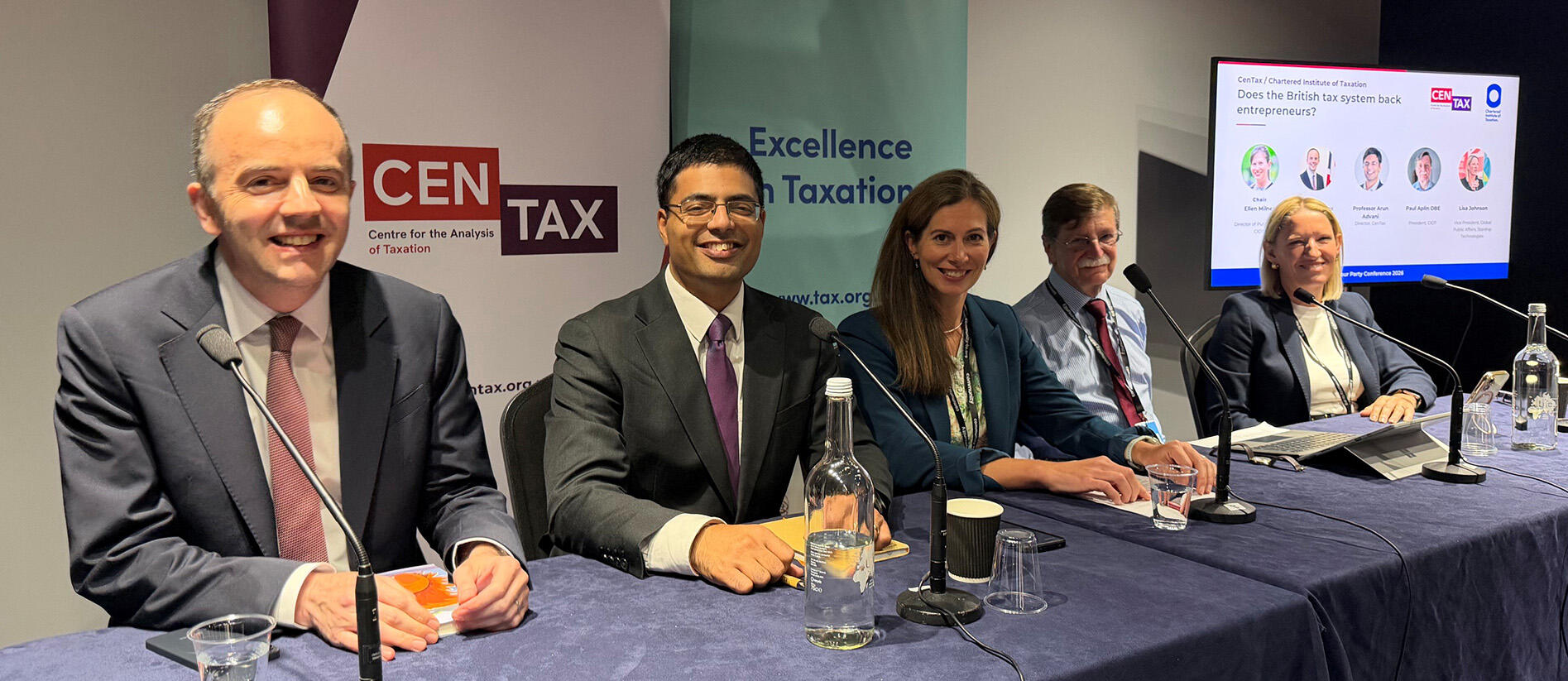
The fringe event at the Labour conference in Liverpool was chaired by CIOT Director of Public Policy Ellen Milner and featured speakers James Murray MP, Financial Secretary to the Treasury, CIOT President Paul Aplin OBE, Professor Arun Advani, Director at CenTax, and Lisa Johnson, Vice President of Global Public Affairs and Corporate Communications at Starship Technologies.
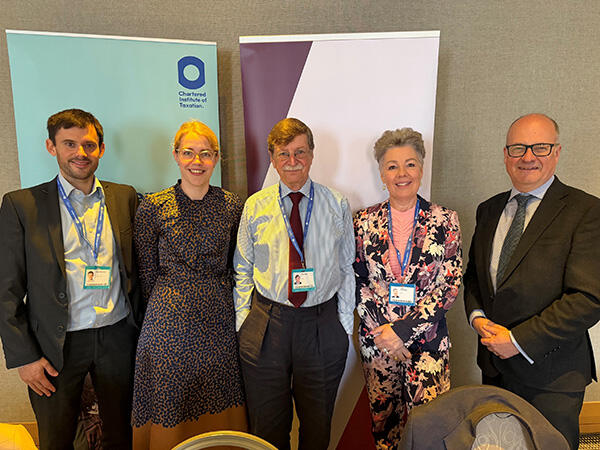
CIOT Chief Executive Helen Whiteman chaired the event at the Conservative conference in Birmingham, alongside speakers Shadow Exchequer Secretary John Cooper MP, Paul Aplin, Professor Andy Summers, Director at CenTax and CBI Head of Tax Policy Alice Jeffries.
Entrepreneurs versus investors
A recurring theme at both conferences was the distinction between what entrepreneurs want and what investors want.
At the Labour conference debate, CenTax Director Arun Advani argued that discussions about entrepreneurship too often blur the distinction between founders and investors.
‘It's important to separate out two different ideas,’ he said. ‘There is one set of people who are building the business and another set of people who are investing in it.’
Advani was critical of aspects of the capital gains tax system, arguing that it simultaneously taxes genuine entrepreneurial investment too heavily while allowing some individuals to convert labour income into more lightly taxed capital gains. He also highlighted incentives affecting emigration and succession planning, suggesting that the system can discourage long-term productive investment.
Drawing on a recent CIOT roundtable involving founders, investors and advisers, CIOT President Paul Aplin noted that there is often a tension between short-term investor objectives and long-term business growth.
‘What entrepreneurs are looking for is not necessarily always the same thing that investors are looking for,’ he said at the Conservative conference. ‘Investors are often looking for a return on their investment in three years and entrepreneurs are looking to take something from idea to reality.’
The roundtable generated strong support for schemes such as the Enterprise Investment Scheme (EIS), the Seed Enterprise Investment Scheme (SEIS), Enterprise Management Incentives (EMI), Venture Capital Trusts (VCTs) and Business Asset Disposal Relief (BADR), said Aplin. But he added that participants also highlighted significant concerns about complexity, uncertainty and administrative burdens.
Aplin warned that growing businesses increasingly need professional advice merely to navigate the tax system.
‘As someone who spent his entire career being paid for giving that professional advice, you might find it surprising, but I actually agree that’s a problem we need to tackle head on,’ he said. ‘Being able to write a cheque for advice should not be a barrier to you starting or scaling a business.’
Reliefs that work – and don’t
The effectiveness of entrepreneurial reliefs was also a major theme throughout both debates. Aplin pointed to examples where tax incentives had genuinely enabled growth. One restaurant business he worked with was able to raise £2 million through EIS funding.
‘We could not have raised that initial capital without EIS,’ he said. ‘The business would not have existed without it.’
Yet panellists repeatedly warned that the reliefs are often overly complicated. Aplin described the legislation as containing not ‘cliff edges’ but ‘elephant traps’, recalling cases where businesses lost relief simply because transactions were completed in the wrong order.
At the Conservative conference, Andy Summers of CenTax questioned whether BADR is now effectively targeted. He described the relief as being ‘the worst of all worlds’, arguing that it is no longer generous enough to influence the behaviour of founders building genuinely large businesses while still benefiting some individuals who would not generally be regarded as entrepreneurs.
Summers suggested that a redesigned relief should focus much more explicitly on supporting founders building high-growth businesses.
The scale-up challenge
The UK is good at producing start-ups but they hit problems when they need to scale up, said Shadow Exchequer Secretary John Cooper at the Conservative conference debate. At the meeting, Cooper described his own experiences as an entrepreneur who set up a news agency before becoming an MP.
Others agreed. Alice Jeffries of the CBI highlighted the UK’s strengths in supporting business formation through investment incentives and employee share schemes, but felt that support for commercialisation and scale-up remains weaker.
‘The UK tax system actually does an excellent job in helping people start a business,’ she said. ‘How about if you want to keep it here, if you want to scale it, if you want to retain businesses in the UK?’
At the Labour conference, Lisa Johnson of Starship Technologies argued that growth depends on much more than tax.
‘Continue celebrating the startup,’ she said, ‘but I think we should be equally serious about the bit that follows, which can really generate economic benefit for us..
Johnson cited examples from the technology and robotics sectors where regulation, procurement rules and public investment decisions can be just as significant as tax incentives in determining whether innovative businesses remain in the UK.
Complexity and administration
At the Labour event, Financial Secretary James Murray emphasised that tax administration is as important as tax policy itself.
‘I don't want people to be spending all of their time working out how the tax system works,’ he said. ‘I want them to spend their time being productive, growing their business, doing what they do best.’
He argued that Making Tax Digital should help move the system towards a future where ‘tax should just happen’.
At the Conservative conference, audience members echoed these frustrations. One engineering business owner described the burden of HMRC enquiries into R&D claims and the complexity involved in accessing incentives intended to support innovation.
Aplin responded by stressing the need for policymakers to spend more time engaging directly with small businesses.
‘I think policymakers need to get out more,’ he said. ‘There’s a big difference in the way you understand the world from data analytics and the way you understand it if you sit with somebody running a small business for a day.’
A question of certainty
While panellists disagreed on some policy prescriptions, there was broad agreement that stability and predictability matter.
Several audience members highlighted the impact of frequent tax changes and questioned whether governments of all colours had done enough to provide a coherent long-term direction.
Summers acknowledged that tax policy inevitably creates behavioural responses but argued that governments should nevertheless communicate a clearer vision.
‘What the government ought to be looking to do is present a clear vision about the structure of the tax system they want to move to,’ he said.
Jeffries agreed, arguing that policymakers should begin by answering two fundamental questions: ‘Who are you trying to support?’ and ‘What are you trying to support them to do?’
More than tax
Perhaps the greatest point of agreement across both events was that entrepreneurship policy cannot be reduced to tax alone.
Infrastructure, access to skills, regulation, finance, energy costs, public procurement and digital connectivity all featured prominently in the discussion.
As Paul Aplin put it in Liverpool: ‘It isn’t all about tax.’
Recordings of the two debates can be accessed here: tinyurl.com/ciotyoutube