



Reducing the Tax Gap: the role of simplification

Share this article



Tax simplification, clearer communication and better use of data can improve compliance, reduce errors and narrow the UK’s Tax Gap.
Key Points
What is the issue?
The government has made reducing the Tax Gap one of HMRC’s key objectives, but achieving this will require more than increased compliance activity. Simpler tax rules, better use of data and clearer communication all have an important role to play.
What does it mean to me?
Tax advisers should expect HMRC to make increasing use of third-party data and analytics to improve compliance, while continuing to focus attention on the small business sector, which accounts for the largest share of the Tax Gap.
What can I take away?
Reducing the Tax Gap is not simply about more enquiries. Tax simplification, better-designed systems, improved taxpayer understanding and effective use of technology can all help to improve compliance and reduce errors.
The current government has set three objectives for HMRC: to improve customer service, modernise the systems used to manage the tax system, and reduce the Tax Gap. At the same time, many people comment that our tax system is too complicated.
What does simplification mean?
In 2021, the Treasury asked the Office of Tax Simplification to write a report on what is meant by simplification.
It actually did us some good to think more deeply about improving the tax system, and we came up with these principles:
- Tax simplification is not a policy objective in itself, but should be a core consideration for government to support taxpayers through the design, implementation and administration of tax policy.
- Lack of clarity on the purpose or outcome of the rules can impact productivity, growth and investment decisions, while unintended incentives create the potential for distortions.
- Undue administrative burdens and unclear obligations create costs for taxpayers, intermediaries, advisers and government.
- Simpler design should make compliance easier and cheaper for taxpayers, while also making the system easier for HMRC to administer.
- People should be empowered to make the right decisions through better understanding of the choices open to them.
Do governments think about tax simplification?
I suspect many people look through all the announcements at a Budget and wonder where tax simplification fits in.
The Scottish government’s income tax rates illustrate the point:
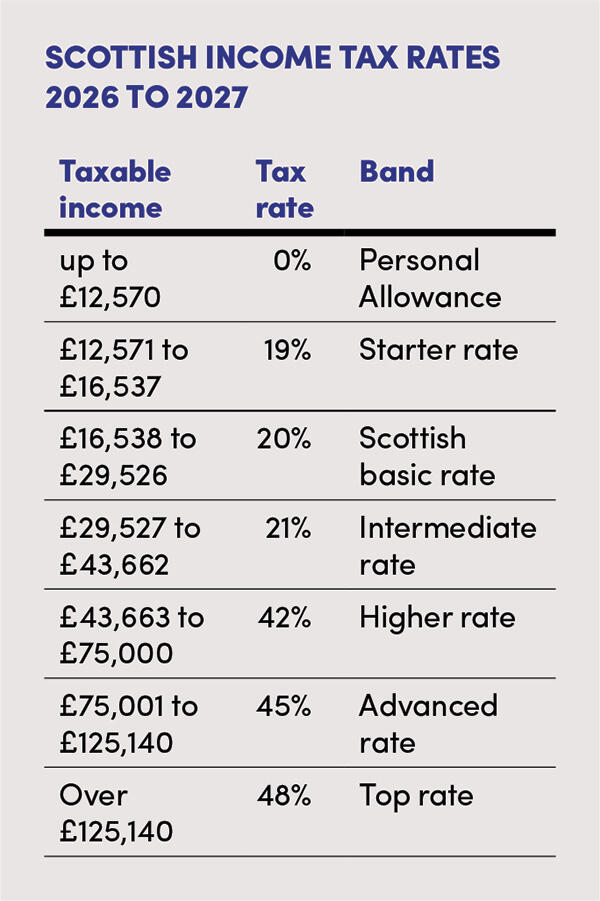
These rates, with six bands and unrounded thresholds, were designed so that a Scottish resident earning up to the median income pays less tax than someone in the rest of the UK. This munificent benefit is worth up to 50 pence per week. It is clearly a matter of political judgement as to whether this is worth the complexity it adds to the tax system.
Westminster hasn’t helped. There was originally a very good reason not to devolve the taxation of savings income to Scotland: the withholding of 20% basic rate tax from interest. But that has not applied for many years and is highly unlikely to return. Yet savings income still has not been devolved, so the unlucky Scottish taxpayer has little chance of working out their tax liability or understanding their effective rates.
I believe that economist and Financial Times commentator Professor John Kay wrote that VAT was only possible thanks to the development of computers. Today, the same applies to income tax.
Lots of people will think of the High Income Child Benefit Charge here. Sir David Gauke was the tax minister at the time, and he has commented on a number of occasions that the government was aware of the complexity of the charge, but that the policy aim was to remove benefits from households where one person earned over £50,000.
I don’t think we, as technical people, can object to the charge simply because it is more complicated. However, we can justifiably ask whether the Treasury and HMRC devoted sufficient resources to minimising the compliance burden on individuals and households.
The High Income Child Benefit charge also highlights another point. Tax is frequently used as part of a wider policy objective. Why wasn’t the DWP asked to introduce a means test on child benefit? The answer is that it did not have the capability. Only HMRC has the ability to levy charges on a wide range of individuals and businesses.
It’s hard to introduce simplification
Timing
The first challenge with any programme to improve our tax system is that it takes time, even when the decision makers are on board. Take, for example, an OTS report, ‘Making better use of third party data’. Our individual tax system is built around PAYE, introduced in 1944. PAYE has evolved, including the addition of National Insurance and benefits in kind. However, it still covers just over 80% of income tax liabilities. What opportunities are there to add extra sources of third-party reporting?
The OTS report was published in July 2021. In April 2023, HMRC issued a consultation, followed by another in 2025, both referencing the OTS work. That has led to legislation and, from April 2028, the system for reporting bank and building society interest to HMRC will be greatly improved, alongside enhancements to card data. This length of time is necessary because both HMRC and data providers need to build systems to manage the data.
Part of the change requires banks and building societies to obtain a taxpayer’s National Insurance number, which is fundamental to making sure that data ends up in the right place rapidly. I think HMRC is on record as saying that it currently matches about 80% of interest data to individual taxpayers; the new system should boost that to over 95%.
This project illustrates the link between simplification and better compliance. There is no doubt that it will reduce the tax gap, as not everyone with taxable income reports it. And I do not mean maliciously – we simply don’t make it easy for individuals to report income outside the Self Assessment regime. The key point, however, is the length of time it takes to introduce something of this scale.
Lack of political credit
One area of complexity is the basic point that not all business expenses are tax-deductible. Of course, it is understandable that there are no deductions for penalties and entertaining, as a matter of public policy. But the nuances over capital and revenue costs are surely unhelpful. Why is there no tax relief for the cost of surveying the seabed to locate wind turbines? Why are the costs of entering into a short lease not deductible, while the costs of renewing it are? Why is there no tax relief for refurbishing a property to let, or installing the usual white goods, yet the costs of replacing existing ones are allowable?
In the world of micro business and micro landlords, we can expect that many claims for business expenses simply go through without anyone realising. In many cases, people in business and landlords will simply claim for business costs. Even when a tax adviser explains the rules, many will see them as making little sense. It is not helped by the fact that the cash basis ignores most of these issues.
Of course, if you’re in the Treasury, you are probably thinking it is unlikely that time or money will be found to fix these obvious problems. But that doesn’t alter the fact that the UK is out on a limb compared to other countries in not simply allowing business expenses to be deductible. It is one of the reasons why overseas investors regard the UK tax system as complex.
Intractable VAT
There’s a lobby to broaden the UK VAT base by removing zero rates and exemptions. The problem, of course, is that voters believe that they bear the cost of VAT.
We all know that better-off people spend more on food because they have more money than less well-off people. But we surely know that if a future government abolished zero-rating on food, it would not only need to develop a new welfare system to support lower-income people but also work out how compensation should be provided. This would be a huge challenge – and it would not address the fundamental problem that voters would not be confident in the fairness of the outcome.
It seems to me that a more helpful approach would be to look at VAT boundaries.
There are tens of thousands of small cafés in the UK. Their owners have to struggle not only with the arcane boundaries within VAT, but also with the unbelievably complex VAT notices and commentaries.
Could we not explore some limited simplification? Cafés face strange and different rules for takeaway food and drinks, as well as differences between cakes and biscuits. Providing, for example, that anything cold taken away should be zero-rated would help a lot. And what about savoury snacks? Potato crisps are standard rated but corn-based chips are not. This encourages manufacturers to reformulate some of their products.
Could government ask HMRC to undertake reviews of areas like these and present them to voters as measures that would help small businesses?
The Tax Gap
The latest Tax Gap data was released on 23 June 2026 (see tinyurl.com/2xy4vcwj). The figures show that the estimated Tax Gap has increased since the 2025 report. The cash value is now estimated to be £59.2 billion for 2024-25, while the gap is at 6.4% of total theoretical tax liabilities.
We should welcome HMRC’s new approach of recognising that relatively firm estimates can be given for three years ago, while the two most recent years are presented as projections. The 2026 figures show that the estimates made last year were too low and the new ‘indicative range’ suggests that in all likelihood the Tax Gap didn’t drop below 6%.
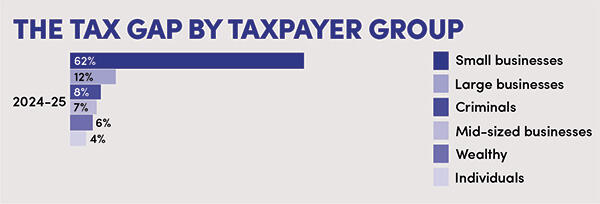
Although large businesses and wealthy individuals often dominate public debate, HMRC estimates that small businesses account for 62% of the overall Tax Gap. As the figure The tax gap by taxpayer group shows, this makes the small business sector by far the single biggest contributor to the gap and explains why improving compliance in that sector is likely to have the greatest impact on reducing the Tax Gap.
Small business compliance checks
HMRC’s 2024-25 Annual Report reveals that the Department carried out 316,000 compliance checks during the year. This government has also funded HMRC to increase its compliance workforce by an additional 5,500 people over five years. We can all work out that even if most of those new recruits focus on micro business and individuals, there will still be limited checks covering the UK’s 5.5 million micro businesses and landlords.
There is also a big question around the value of a micro business check, given that the additional tax recovered per taxpayer is so much lower than for Large Business and Wealthy & Mid-size taxpayers.
However, there is a widespread belief that the likelihood of an enquiry is lower today than it was in the past. Arun Advani of Warwick University published a paper some years ago on the value of tax audits, noting that taxpayers paid more attention to compliance for several years after an audit, before gradually slipping back into old habits.
This suggests that there is a benefit to the Exchequer, and perhaps to overall tax morale, in HMRC increasing the number of compliance checks into micro businesses.
Other approaches to small business
However, closing the Tax Gap will require other approaches. Most people in business assume that all their expenses are tax-deductible. They often struggle to distinguish expenses deemed to be personal.
The difference between subsistence costs and entertaining can sometimes be blurred. Someone working in a café may buy a coffee and something to eat while using the café’s Wi-Fi – but is that a personal cost? By contrast, paying more for a desk in a shared workspace often brings free drinks and food, which are treated as incidental to the deductible cost of the workspace.
Should we update the rules so that they are more aligned with modern working practices? We might also consider introducing flat-rate allowances for certain categories, such as home‑working expenses or the cost of broadband. Better use of data is another important part of HMRC’s strategy to reduce the Tax Gap (see HMRC’s growing use of third-party data).
HMRC's growing use of third-party data
Everywhere we look, we see a growing need for data so that HMRC can make appropriate enquiries as part of its strategy to improve compliance and reduce the Tax Gap. Potential sources of information include:
- country-by-country reporting to tax authorities;
- the International Controlled Transactions Schedule (ICTS);
- the recently closed consultation on data from directors’ loan accounts; and
- the recently introduced and forthcoming third-party data provision to HMRC and other tax authorities, including bank and building society interest, platform sales, crypto assets, and credit and debit card data.
This is a deliberate strategy to gather more and better data so that analytics can support upstream and downstream responses. Upstream means preventing errors through legislative or administrative change, or by alerting taxpayers to possible issues before they file.
HMRC’s Transformation Roadmap also highlights significant investment in data capture and processing. This raises wider questions about the future direction of the tax system. For example, should we consider dropping the use of simplified three-line accounts within Making Tax Digital if more detailed reporting could improve compliance?
Better data not only improves tax compliance but can also benefit taxpayers. Pre-population is the obvious benefit, whether through more accurate tax codes for PAYE, figures automatically included in Making Tax Digital and Self Assessment returns, or by displaying data that HMRC holds from taxpayers’ online accounts and the HMRC app, so that it can be checked before returns are submitted.
Back to simplification: language
Every profession, activity and business organisation has its own beloved jargon. We sometimes assume that the objective is to make taxpayers learn our tax jargon, instead of thinking about how normal people might understand it.
Perhaps the most egregious example is the Self Assessment tax return. What does that term mean to any normal person? There isn’t actually any element of ‘self’ in it. HMRC specifies the exact information it requires through the layout of the return. It then performs the tax calculation or requires third-party software to use its calculation. Wouldn’t it be simpler just to call it a Personal Tax Return?
In conclusion
Closing the Tax Gap works best when it is combined with simplification. Looking again at tax reliefs and how they align with modern practice could reduce error at relatively modest cost. We also need to make tax easier to understand by adapting our language, rather than expecting taxpayers to learn ours.
Third-party data, and the many ways it can be used, will help both taxpayers and HMRC to reduce the Tax Gap. Pre-population has clear benefits, but we must also consider the risks and the question of taxpayer responsibility.
Embedding tax rules within software could also improve compliance, but it would need some reconsideration of the underlying rules. Setting consistent, enforceable standards for software developers is important, and working out how best to bring everyone along will take time and broad discussions.
This article draws on the Hardman lecture delivered by the author on 29 June 2026.
© Getty images