



From relief to exposure: estate planning for business owners

Share this article



Business owners should review succession plans following business relief reforms, using practical strategies to manage, fund or reduce inheritance tax exposure.
Key Points
What is the issue?
The restriction of business relief from 6 April 2026 means many business owners may face significant inheritance tax liabilities for the first time.
What does it mean for me?
Business owners should review their succession plans early to ensure there is a strategy to fund or manage any inheritance tax exposure.
What can I take away?
Lifetime gifts, trusts, insurance, liquidity planning and, in some cases, international structuring may all help, but require careful, tailored advice.
Many shareholders in family and owner-managed businesses will face an inheritance tax exposure on succession that previously may not have existed. The new combined £2.5 million allowance applies to the value of property that would otherwise qualify for 100% business relief or agricultural property relief (APR). Qualifying value above that allowance will generally receive relief at 50%, producing an effective inheritance tax rate of 20% on that excess, assuming the 40% death rate applies.
For high-value private company shareholders, this can create a significant liquidity problem. A £50 million trading company that previously might have passed free of inheritance tax could now give rise to a £9.5 million liability, before taking account of other reliefs or exemptions. This article focuses on the practical considerations for shareholders who hold qualifying business assets and have not yet considered how the post-6 April 2026 business relief rules will affect their succession plans. It does not cover the detailed mechanics of the new business relief regime, the tests for qualifying assets or the excepted asset rules in detail, except where noted below.
Commercial and family considerations
Before turning to the tax analysis, the shareholder’s family position, commercial objectives and wealth aspirations should be considered. Relevant questions include:
- Does the shareholder have a spouse or civil partner?
- Does the shareholder wish to pass the business to the next generation?
- Are children or wider family members involved in the business and capable of assuming ownership or management responsibility?
- Is the business likely to be sold, retained, transferred to the next generation or managed by non-family executives?
- Does the shareholder have philanthropic ambitions?
- Does the shareholder wish to protect the business for future generations?
- Could the shareholder or their family cease to be long-term UK resident?
These objectives will often determine whether outright gifts, trust structures, insurance, shareholder agreement changes or a sale are appropriate options. Once they have been explored and understood, the tax position can be considered. The changes to the operation of business relief and APR from 6 April 2026 make that analysis more complex, and planning should retain sufficient flexibility to accommodate changes in personal circumstances, the economic environment and future tax rules.
The ‘do nothing’ scenario
Once the non-tax considerations have been addressed, it is helpful to consider the practical effect of the new rules. For example, a shareholder who dies owning a £50 million private trading company could face a significant inheritance tax liability under the post-6 April 2026 regime.
Assumptions:
- The deceased held 100% of the shares in a private trading company valued at £50 million.
- The shares qualify in full for business relief, including 50% relief on the value above the £2.5 million allowance. There are no excepted assets or non-qualifying subsidiaries, although this should be kept under review.
- The nil-rate band has already been used against other assets.
- No spouse or civil partner exemption applies.
- Only one £2.5 million 100% relief allowance is available. No transferable allowance is claimed.
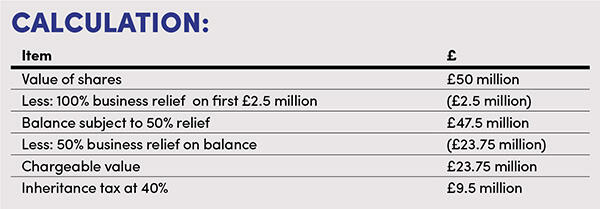
On these assumptions, the £2.5 million allowance shelters the first part of the value in full. The remaining £47.5 million receives 50% relief, leaving £23.75 million chargeable to inheritance tax. At 40%, the resulting liability is £9.5 million. See the calculation in the box above.
Where a transferable spouse or civil partner allowance is available and claimed, the 100% relief allowance could increase to £5 million. In that scenario, £45 million would be subject to 50% relief, resulting in a chargeable value of £22.5 million and inheritance tax of £9 million.
Share valuation is critical in determining inheritance tax exposure. Professional valuation advice should be sought, particularly where issues such as minority or control discounts, shareholder rights or recent arm’s length transactions may affect the valuation.
The options broadly fall into four categories: funding the liability; transferring value during lifetime; preserving relief; and considering residence and situs issues. Due to the inheritance tax reforms, lifetime options may warrant review even where no immediate action is required.
Liquidity considerations
The central question is how the inheritance tax liability will be funded. Even with the instalment regime, an estate needs sufficient funds to meet the liability over time without destabilising the business. Advice should consider the cost of funding, including any tax cost of extracting funds from the company.
1. Instalments
From 6 April 2026, property qualifying for business relief or APR falls within the interest-free instalment regime, subject to the statutory conditions. Broadly, the tax attributable to qualifying property may be paid in ten equal annual instalments if written notice is given to HMRC.
For a transfer on death, the first instalment is due six months after the end of the month of death. Instalments on property qualifying for business relief or APR are generally interest-free where the statutory conditions are met and each instalment is paid on time.
The instalment regime is a cash-flow mechanism rather than a funding solution. The tax remains due in full; the instalments merely spread the payment obligation over time. The unpaid balance may become due immediately if the relevant property is sold. Interest may also arise in certain circumstances, including a late assessment, an increase in the tax payable or a sale of the property. In the £50 million example below, instalments may reduce the immediate liquidity pressure, but they do not remove the need to fund the £9.5 million liability over time.
2. Life assurance
One option is a whole-of-life or term insurance policy providing a dedicated sum to meet inheritance tax liabilities. Where policies are written in trust for the intended beneficiaries, the proceeds should generally fall outside the insured’s estate for inheritance tax purposes, provided the trust is properly established and maintained.
The cost of premiums must be weighed against the benefit, particularly for older or higher-risk policyholders. Cover should be reviewed periodically against the value of the business and the expected inheritance tax exposure.
3. Company-funded
The company itself may provide the source of funds. Potential mechanisms include a post-death buyback of shares, the redemption or cancellation of shares, a loan or a dividend. Where a post-death purchase of own shares is contemplated, advisers should consider the company law requirements, including distributable reserves, together with the tax treatment of the payment received by the estate. Where such a purchase is used to fund inheritance tax, advisers should also consider the specific inheritance tax provisions dealing with company purchase of shares from an estate. These include the requirement that the proceeds are applied in satisfaction of inheritance tax within the relevant period and the restrictions where the liability could reasonably be met from other resources without undue hardship. The income tax treatment of a purchase of own shares should not be assumed to be capital in nature: income treatment may apply unless the statutory capital treatment conditions are satisfied.
All options require careful analysis of the relevant company law requirements, together with the income tax, capital gains tax and corporation tax consequences.
Depending on the route under consideration, key areas are likely to include the transactions in securities rules, business relief qualification, excepted asset status and, where relevant, the loans to participators rules. Share valuations may also be advisable.
In short, funding an inheritance tax liability by extracting funds from the company may be an option, but it raises significant complexity because of the number of potentially interacting rules. Whether it is appropriate will depend on the precise facts and circumstances.
4. External liquidity reserves
Building a separate investment pot outside the trading company can provide liquidity to meet inheritance tax on the business assets. However, that fund may itself form part of the inheritance tax estate. To meet the £9.5 million liability in the example above, a separate investment fund of around £16 million would be required if that fund is also subject to inheritance tax at 40%. The fund would need to grow broadly in line with any increase in the value of the business and the associated inheritance tax exposure, requiring periodic review.
Lifetime transfers
Transferring value during lifetime remains one of the most effective ways of reducing the value of the death estate, although the reforms introduce some additional considerations.
1. Outright gifts
An outright lifetime gift can be effective where it fits the shareholder’s overall succession and wealth plan and there are appropriate family members to receive the shares. A lifetime gift of shares to an individual will generally be a potentially exempt transfer.
If the donor survives seven years, the gift falls outside the scope of inheritance tax. This may be relevant for shareholders who wish to pass on their businesses during lifetime, whether by a single transfer or a series of gifts, although the seven-year window applies to each gift. However, there are tax considerations for such a transfer:
- Gifts between connected persons, including shareholders and their children, are treated as deemed disposals at market value for capital gains tax purposes. Gift relief under TCGA 1992 s 165 may prevent an immediate capital gains tax charge, but eligibility should be considered at an early stage. In particular, the residence position of the donee, the nature of the shares and any later change in residence within the clawback period should be reviewed, as relief may be restricted or clawed back.
- If the donor dies within seven years, the potentially exempt transfer becomes chargeable. Business relief may still be available on death, but the conditions must be tested carefully, including whether the donee still owns the relevant business property or qualifying replacement property at the relevant dates.
For example, where the shares were gifted in full five and a half years before the donor’s death, assuming they continue to qualify for business relief and ignoring the nil-rate band position, the donee would likely face an inheritance tax liability of £3.8 million after business relief and taper relief. In this scenario, tax would be charged at 40% of the usual 40% rate due to the application of taper relief.
Although this is £5.7 million less than the ‘do nothing’ scenario, it remains a substantial liability. Subject to the wider planning undertaken, donees may therefore wish to consider term life assurance on the donor’s life during the seven-year period to provide liquidity should inheritance tax become payable.
2. Discretionary trusts
Where a shareholder does not wish to gift shares directly to descendants, or is not yet sure who should receive them, a discretionary trust may be appropriate.
Unlike a direct gift to an individual, a gift to a discretionary trust is a chargeable lifetime transfer and may give rise to an immediate inheritance tax charge. Before 6 April 2026, the chargeable lifetime transfer may have been reduced to nil where unrestricted 100% business relief was available. From 6 April 2026, however, 100% business relief is available only within the £2.5 million allowance and a lifetime transfer may therefore give rise to an immediate inheritance tax charge.
A phased programme of transfers into trust may be considered, although the interaction between the £2.5 million allowance, the donor’s cumulative transfer history, the relevant property regime and possible death within seven years should be carefully modelled. As with direct gifts, there are other tax considerations:
- A gift into a discretionary trust is treated as a disposal by the donor and could trigger capital gains tax. Holdover relief under TCGA 1992 s 260 may be available for gifts that are chargeable transfers for inheritance tax purposes, and s 260 may apply even where the inheritance tax charge is reduced by business relief. The availability of s 260 is wider than that of s 165 gift relief, but restrictions must still be considered, including where the trustees are non-UK resident, the settlement is settlor-interested or residence-related clawback rules apply.
- Where the donor dies within seven years of the gift into trust, further inheritance tax may arise, depending on the extent to which the transfer is covered by 100% business relief.
- Trusts also involve ongoing costs, including ten-year and exit charges, which should be modelled alongside the shareholder’s longer-term succession objectives.
Other lifetime planning options with additional advice may also be appropriate. Selling shares to family members and crystallising an upfront capital gains tax charge can be advantageous. Similarly, the bifurcation of shareholdings could support an orderly transfer of future growth in the business to the next generation.
International considerations
A business expanding globally may already be assessing whether a new international holding company structure would deliver commercial benefits. In that context, the shareholder’s personal tax residence position should also be considered.
An individual who has been UK resident for at least ten of the previous twenty tax years will generally be treated as long-term UK resident and within the scope of UK inheritance tax on their worldwide assets. If they later become non-UK resident, they may remain within the scope of UK tax for between three and ten tax years, depending on their prior UK residence history.
Once an individual is no longer long-term UK resident, non-UK assets should generally fall outside the scope of UK inheritance tax, subject to important exceptions including UK-situs assets, UK residential property-related rules, trust rules and anti-avoidance provisions. Where the individual also holds shares in a non-UK holding company that are not caught by those exceptions, it may be possible for those shares to pass on death without a UK inheritance tax charge.
Such planning would only be appropriate where there is a genuine commercial rationale for an international holding structure and where it also aligns with the family’s wider aims. Even then, the planning requires careful consideration of the particular facts and circumstances before any action is taken. Relevant issues include the statutory residence test, the transfer of assets abroad and settlements rules, capital gains tax exit and reorganisation issues, UK situs and UK residential property-related rules, relevant estate or inheritance tax treaty positions. From a corporate perspective, transfer pricing, economic substance, CFC rules, interest deductibility and withholding tax should also be considered.
In conclusion
For family and owner-managed businesses, succession planning extends beyond tax. Commercial and family objectives should be considered before assessing how the reforms might affect a shareholder’s succession plan. However, the reforms to business relief mean that, for shareholders in businesses valued significantly above the £2.5 million allowance, there may now be a real and material inheritance tax liability where none was previously expected.
Opportunities remain to prepare for, fund or mitigate the liability. The instalment regime, lifetime transfers, insurance and international considerations may all have a role. However, each requires careful analysis of the specific facts and circumstances, together with sufficient time for implementation.
Inaction carries an increasing cost. As business values grow, so does the potential inheritance tax exposure. Business owners should address these issues early enough to evaluate the available options, implement an appropriate strategy and seek professional advice.
© Getty images