



Tax disputes: the convergence of risk

Share this article



Tax disputes are becoming more complex, making them harder to avoid – and more important to prepare for.
Key Points
What is the issue?
Baker McKenzie’s Convergence of Risk research shows that tax disputes are a significant concern for multinational businesses, driven by regulatory fragmentation, fiscal pressure, shifts in tax authority positioning and the digitisation of tax administration.
What does it mean to me?
Tax controversy is becoming harder to manage across jurisdictions, while data-driven enforcement means that technically sound positions may still be vulnerable if the underlying evidence, data and documentation cannot be readily accessed and explained.
What can I take away?
Businesses should treat dispute readiness as part of tax risk management, prioritising positions most likely to face challenge or material exposure and focusing on centralised oversight, contemporaneous documentation and defensive files.
For multinational businesses, tax disputes are becoming harder to contain. A position that attracts little attention in one jurisdiction may be challenged in another.
For many years, the risk of tax authority challenge – often referred to as tax controversy risk – was viewed largely as a consequence of a specific transaction, an audit or a technical disagreement with a tax authority. This is changing. Regulatory fragmentation, fiscal pressures, persistent uncertainty and the rapid digitisation of enforcement are combining to create a more contentious landscape.
The scale of the concern is reflected in Baker McKenzie’s 2026 Global Disputes Forecast, which surveyed 600 senior legal, risk, compliance and tax decision-makers worldwide. It found that tax disputes were expected to be the second-greatest source of dispute risk over the coming year.
A follow-up survey, including 100 respondents in tax roles, shows what is driving that concern, including regulatory fragmentation, shifts in tax authority positioning, fiscal pressure and the digitisation of tax administration (see ‘The convergence of risk: tax disputes’ at tinyurl.com/4kdtz2p6).
The message is clear: tax controversy can no longer be managed as an occasional event. For tax teams, the question is not simply how to respond when a dispute arises, but how to identify and prepare for potential challenges before they do.
A more fragmented environment
Regulatory fragmentation lies at the heart of the problem. In Baker McKenzie’s research, 84% of tax respondents were concerned that diverging tax rules and approaches across jurisdictions are increasing their organisation’s exposure to disputes.
Multinational businesses have always had to navigate differences between tax regimes. What is changing is the extent to which jurisdictions may differ not only in their legislation, but in how tax authorities interpret and enforce existing rules.
Concepts such as beneficial ownership, economic substance and anti‑abuse provisions, as well as the application of treaty benefits, are increasingly attracting different approaches from different regimes.
That presents a particular challenge for businesses that have centralised or regionalised their tax functions. A global tax team may seek to maintain a consistent position, while having to respond to different rules, interpretations and enforcement priorities in individual jurisdictions.
The answer is not to abandon centralised oversight, but to combine it with strong local intelligence. Clear escalation protocols and regular cross-border coordination can help businesses to identify developments that may affect structures, documentation or audit strategy at an early stage. Local changes can then be considered as part of the business’s global tax controversy risk, rather than treated as isolated compliance issues.
Fiscal pressure and tax authority scrutiny
Alongside regulatory fragmentation, fiscal pressure is also increasing the risk of tax controversy. In the survey, 81% of tax respondents viewed fiscal pressure as a significant contributor to tax controversy risk, while 82% cited shifts in tax authority positioning.
As governments face economic and political pressure to protect revenues, tax authorities are becoming more assertive in their audit activity and more willing to challenge taxpayer positions. For tax teams, that can mean broader information requests, more aggressive interpretations of anti-avoidance rules and closer scrutiny of transactions that might previously have attracted limited attention.
A position that has not previously been challenged cannot necessarily be assumed to be low risk. Tax teams need to consider not only whether a position is technically sound, but whether it is likely to attract scrutiny and whether the evidence needed to defend it is readily available.
The particular areas of focus will vary between jurisdictions, but greater enforcement activity is being seen across both developed and emerging markets. For multinational groups, understanding where tax authority approaches are changing is becoming an important part of assessing dispute risk.
The rise of data-driven enforcement
Digitisation of tax administration is creating another source of potential dispute. Nearly three-quarters of tax respondents (73%) believe that increased digitisation is creating new dispute risks.
Tax authorities are investing heavily in analytics, automation and artificial intelligence to identify anomalies, compare taxpayer behaviour and select audit targets. Historically, many issues were brought to their attention by manual reviews or industry-focused campaigns. However, authorities are increasingly using large datasets to identify inconsistencies and decide where to investigate.
This changes what tax teams need to prepare for. A technically supportable position may not be enough if the underlying data is incomplete, inconsistent across jurisdictions or difficult to retrieve and explain. Data readiness therefore needs to begin before an audit. Tax teams should know who owns the relevant data, whether consistent standards are being applied and how quickly information can be retrieved and reconciled across jurisdictions. Documentation should also support the positions that the organisation may ultimately need to defend.
These are not simply administrative concerns. Gaps, inconsistencies or delays in producing information can make even a sound technical position more difficult to defend and may themselves give a tax authority grounds for further challenge.
The expanding scope of tax disputes
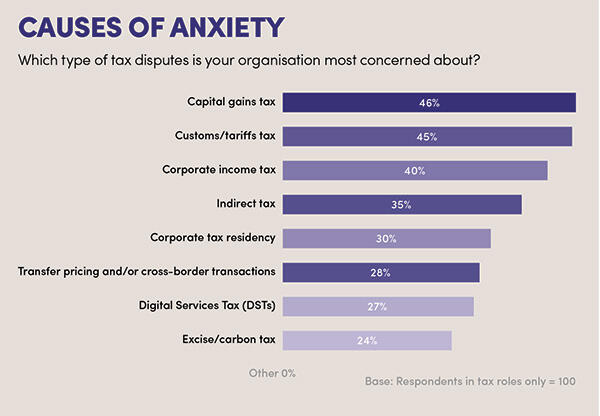
The areas giving rise to tax controversy are also becoming more diverse. Tax respondents identified capital gains tax (46%), customs and tariffs (45%), and corporate income tax (40%) as their primary areas of concern.
Transfer pricing and cross-border transactions were identified as a top dispute risk by only 28% of respondents. But that figure does not tell the whole story: transfer pricing issues are also embedded in other areas of dispute, particularly customs and tariffs and corporate income tax.
Capital gains tax
Capital gains tax was the leading area of concern, identified by 46% of respondents. Disputes are being driven by increased scrutiny of asset disposals, holding structures and the application of anti-abuse concepts as governments seek to protect tax revenues. In EMEA, tax authorities are applying anti-abuse and beneficial ownership concepts when considering participation exemptions and exit taxes. This can create particular uncertainty for private equity and venture capital structures, as well as group structures involving intermediate holding companies.
Customs and tariffs
Customs and tariff disputes were a concern for 45% of respondents, against a background of geopolitical uncertainty and evolving trade policies. These disputes can be particularly significant because they are generally based on transaction value rather than profit. Preparing for a customs audit requires a detailed understanding of the supply chain and the ability to produce supporting documentation. This can expose a practical weakness: the systems used to manage customs information may be more closely linked to internal reporting and may not have been designed with a tax authority audit in mind.
Many customs issues also now overlap with transfer pricing considerations, creating the potential for challenges from multiple authorities based on the same set of facts. When drafting intercompany agreements, businesses therefore need to evaluate not only transfer pricing and withholding tax, but also the potential customs implications.
Corporate income tax
Corporate income tax was identified as a top concern by 40% of respondents. Disputes in this area are being driven by transfer pricing, profit allocation and cross-border structuring, against an increasingly complex international tax framework.
In the US, transfer pricing remains a particular area of contention, alongside the Internal Revenue Service’s application of the codified economic substance doctrine to transactions it considers tax-motivated. The potential penalties associated with both can add significantly to the exposure for corporate taxpayers.
Pillar Two
Complexity is likely to increase as the OECD’s Pillar Two global minimum tax framework takes effect across more jurisdictions. As governments introduce and refine their local rules, differences in how the global minimum tax framework is applied and interpreted remain inevitable.
For multinational groups, the challenge will be managing those differences across jurisdictions. Competing interpretations and differing compliance expectations could lead to disagreements over taxing rights and how the methodologies should be applied in practice.
These areas show why tax risks cannot always be considered in isolation. A decision taken for one tax purpose may have consequences elsewhere, making it increasingly important for tax teams to understand how positions interact across different taxes and jurisdictions.
Moving to a more resilient position
A technically sound tax position is only part of the defence. Businesses also need to be able to access, organise and present the evidence supporting that position when it is challenged. That can be difficult when resources are already stretched. The survey identified resource constraints (43%), coordination difficulties (41%), jurisdictional complexity (40%) and documentation gaps (34%) as the most significant challenges associated with managing cross-border disputes.
Organisations can make the most of limited resources by prioritising the disputes and tax positions that present the greatest likelihood of challenge and the highest potential exposure. This means moving from a reactive to a risk-based approach, with centralised oversight, clear internal ownership and coordinated input from tax, legal, finance and operations.
Focusing preparedness on measures that can be used across different disputes – such as defensive files, audit playbooks and consistent documentation – can improve dispute readiness without trying to address every risk with the same intensity. Within that risk-based approach, three areas deserve particular attention.
Central oversight: Centralised oversight of audits and controversies across jurisdictions can improve coordination and help businesses maintain consistent positions. It also allows lessons learned in one jurisdiction to be applied elsewhere.
Contemporaneous documentation: This is generally more complete and accurate, as well as significantly less expensive to assemble, than documentation developed years later during an audit. Preparing it at the time of a transaction can therefore put the business in a much stronger position if that transaction is subsequently challenged.
Defensive files: These should focus on the highest-risk positions: those most likely to attract scrutiny and generate material exposure. Together with audit playbooks and consistent documentation, they can help tax teams prepare for the disputes that matter most, rather than trying to anticipate every possible challenge.
In conclusion
Tax disputes are becoming more complex and more international in scope. Tax controversy can no longer be treated simply as a response to an individual audit or transaction. For multinational businesses, identifying where challenges are most likely to arise, and ensuring that the people, evidence and documentation needed to respond are in place, should form part of day-to-day tax risk management.
We would like to thank Jorge S. Narváez-Hasfura, Allen Tan, Mounia Benabdallah and Miles Humphrey for their assistance with this article.
© Getty images