

CIOT President's incoming speech: Digital systems must be co‑created with tax profession
Share this article



In his speech to CIOT’s Annual General Meeting on 4 June, incoming President Paul Aplin will say that ‘co-creation’ came late to MTD; for further digital developments it needs to be built in from the start.
A long time ago, in what now feels like a galaxy far, far away, I began my career in tax. I joined a Westcountry firm of accountants in 1980, qualified as a Chartered Accountant in 1985 and then as a Chartered Tax Adviser in 1989. Eight years later, I was involved in a moment of tax history. It changed the entire course of my career – and, indirectly, some of yours.
A moment of transition
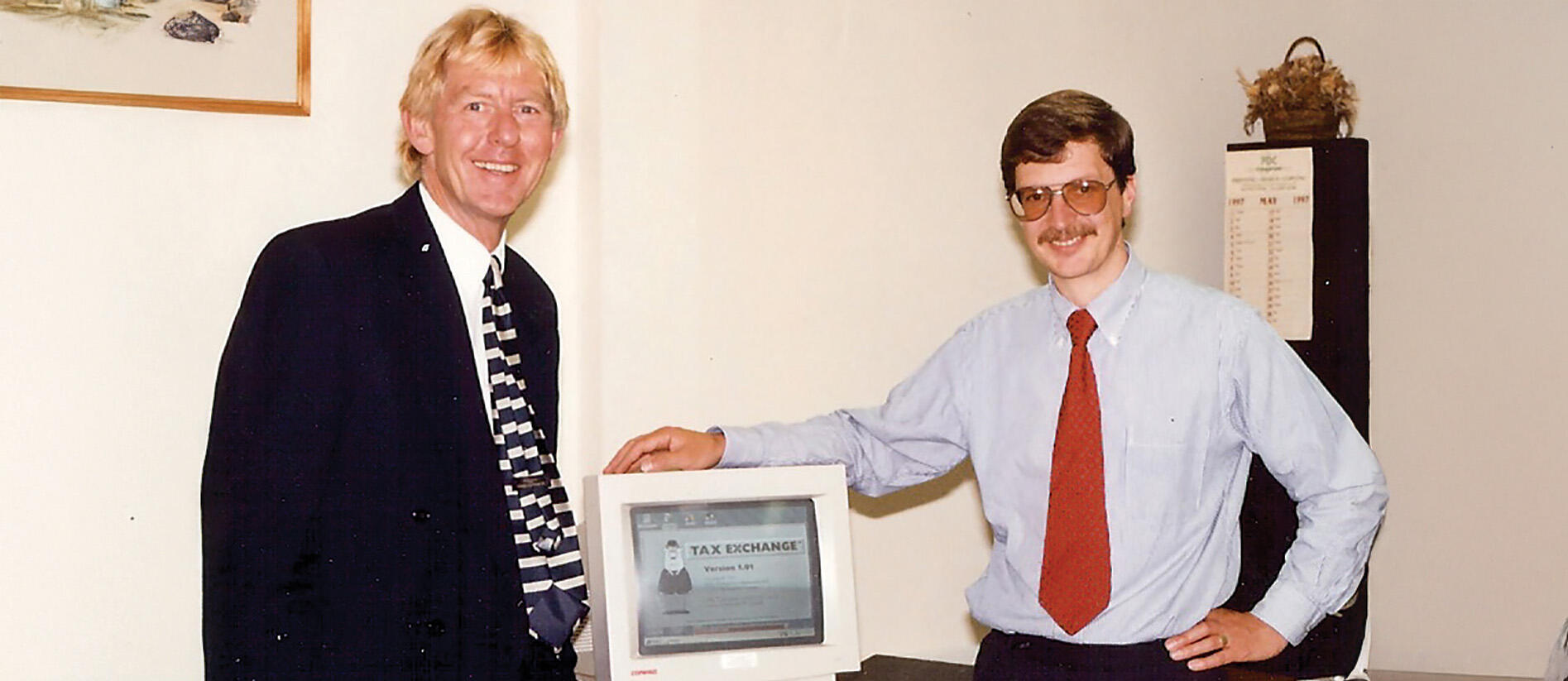
It took place on 23 April 1997. I have a photograph of it, in which I am standing on one side of a computer that now looks like a museum piece, but which was then cutting-edge technology; on the other side stands my friend John Coupe, then an Inspector of Taxes at Taunton 2 Tax District.
It was a time of huge change in tax administration.
We were moving from an ‘assessment’ system, where we submitted figures on a tax return and the Inland Revenue issued an assessment based on those figures, to a Self-Assessment system in which we prepared both the return and calculation, which the Revenue then processed and – at their option – checked later. The system was being turned on its head.
And given the need to prepare the calculations as part of the return, this was when many smaller firms first began using tax software.
The photograph captures the moment of transition from Tax Administration 1.0 (a paper-based world) to Tax Administration 2.0 (a world in which forms were electronic). We had just filed the UK’s first ever electronic personal tax return.
Some said that e-filing would only ever be suitable for simple cases; some objected to having to buy IT equipment; some worried about data security and others about job security. Familiar responses to digital change. But it reduced our costs, increased our efficiency, improved our client service and the size of our tax department increased.
Now, 29 years later, around 97% of personal tax returns are e-filed as a matter of course. Unsurprising then that technology has been a major theme of my career in tax. And one that I want to focus on over the coming year.
But the photograph captures something equally fundamental to the tax system and to my life – and yours – in tax: the working relationship between agents and HMRC.
The day before we filed that first electronic return, I called John and asked if he would like to see how we prepared the return and then be present when we fired it down the line.
The day after we had filed it, John invited me to his office to see what the Inland Revenue system had received. After a few phone calls, we discovered that he could not view it on his computer screen but had to request a printout from Shipley. It came in the Internal post.
Rome wasn’t built in a day.
A matter of trust
My point is this: John and I both regarded it as obvious that we should see and understand the process from each other’s point of view.
It involved a degree of mutual trust that was so ingrained that we didn’t even think about it. Let me dwell for a moment on that theme of trust and common interest.
John and I argued regularly over tax issues: what was allowable and what wasn’t; what was a reasonable stock valuation or provision and the correct treatment of a particular item. We knew when and how to fight our corner. We respected each other’s professionalism.
Yes, it was easier then when we had local tax offices and knew each other personally. And perhaps what we witnessed that day in 1997 was the advent of the very technology that would – in part – facilitate a less personal, more remote relationship.
We will never go back to the world as it was in 1997. The change is irreversible. But the need to work together effectively and to respect and understand each other’s roles in making the tax system work is as important now as it was then.
Complexity and simplification
The UK system has become hugely more complex over the 46 years I have been involved in tax. Remarkably, despite that increased complexity, it still enjoys – and indeed relies on – a very high level of voluntary compliance. By international standards, the UK tax gap is low.
Some taxpayers, however, really struggle with the complexity they face and the work of the tax charities, and my CIOT colleagues in the Low Incomes Tax Reform Group, to support them is vital.
The need for simplification is therefore another strand in my story. It is the topic for this evening’s CTA Address, given by David Gauke, former Treasury Minister who will be joined by my former OTS Board colleagues Professor Judith Freedman and Dame Teresa Graham.
The need for simplification is not just about making it easier to comply successfully, but about helping to reduce the administrative burden of compliance – the raison d’être for HMRC’s Administrative Burdens Advisory Board, which Dame Teresa chairs. For smaller businesses, that burden can be disproportionately high, in part perhaps because the challenges they face are not always understood sufficiently to be fully reflected in policy design.
So, technology, the relationship between HMRC and the profession, effective tax administration, simplification and reducing administrative burden, are all captured in that photograph.
What can we do?
What can – and do – we at CIOT actually do on these fronts?
Firstly, it is important to say that we have an obligation under our Royal Charter – and as a charity – to speak and act in the public interest; we also have a Charter obligation to educate. Our discussion on tax simplification this evening is driven by both of those obligations.
And former CIOT President Bill Dodwell will be delivering the ICAEW Tax Faculty’s Hardman Lecture on simplification at the end of this month.
Our two Institutes maintain a close working relationship – I am a member of the Tax Faculty Board – and we will be meeting over the summer to talk (amongst other things) about how we keep this ball rolling.
We will also be following up on our joint CIOT/ICAEW HMRC service standards survey and report, asking members to tell us about the issues they are facing and making practical, constructive recommendations to HMRC.
On technology, we are in the process of our annual ‘refresh’ of the CIOT Diploma in Tax Technology to ensure that it remains up to date. Alongside DiTT we have our short AI in Tax course. And we will continue to work to keep the PCRT (Professional Conduct in Relation to Taxation) guidance relevant in a digital world, as we have recently with additional guidance on AI and MTD. We have refreshed our education governance structure and overhauled both the CTA and our Joint Programmes with ICAEW and ICAS.
We are doing a lot more besides.
Our relationship with HMRC
I’d like to turn again to our relationship with HMRC. This is also rooted in our public interest obligations.
We need a relationship with HMRC based on trust, shared purpose and a willingness to be candid, even when it is difficult. Perhaps especially when it is difficult. Let me illustrate what I mean by that.
MTD was first announced in 2015. Until around three years ago, if anyone had asked me what we had achieved through the many, many hours of engagement with HMRC on it I would have had to say ‘nothing’.
Things changed fundamentally three years ago. The dialogue opened up. There was a genuine willingness to listen to our concerns and to those of other stakeholders. The End of Period Statement was dropped, it was agreed that quarterly returns should be cumulative rather than stand-alone – avoiding the need to correct already-filed returns perhaps numerous times – and functionality was added in order to enable multiple agents to engage with HMRC.
The term ‘co-creation’ also began to be used, with sessions bringing together HMRC, software developers and representative bodies to look at key aspects of MTD.
Co-creation recognises that there are multiple stakeholders in tax administration and that to maximise efficiency, to minimise complexity, to minimise administrative burdens and to drive down the tax gap we all have a role to play: not a script written by any one party, but one that we write together.
Co-creation came late in the day for MTD. There were things we could change – and as I have said, did change – but other elements were too baked in to change at such a late stage.
To build better tax administration processes, the principles of co-creation, of sharing the problem rather than a partially worked-up solution, of listening to all voices at the very earliest stage and before design work starts must be hard-wired into HMRC’s approach.
Optimist or pessimist?
Am I feeling optimistic? Actually, yes, I am. I was greatly reassured to hear HMRC’s First Permanent Secretary J P Marks speak about ‘working in the open’ at last year’s CIOT Cambridge conference, by hearing his HMRC Executive Committee colleague Jonathan Athow speak about the importance of ‘sharing the problem’ in his opening remarks at HMRC’s last Stakeholder Conference, by the references to co-creation in HMRC’s Transformation Roadmap and by the workshops that have been taking place over recent months to create a framework for this new way of working.
It will be critical to the success of the new digital initiatives set out in the Roadmap, initiatives that will move us beyond MTD into the world of Tax Administration 3.0.
A world where we make best use of data, closer to real time; where we make effective use of AI, which brings new challenges as well as new opportunities, and where we begin to build compliance into taxpayers’ natural systems. A world where we harness the power of technology – through prompts and nudges at the point of transaction recording for example – to drive compliance upstream. Where we use technology to drive efficiency, reduce complexity, reduce administrative burdens and give taxpayers the best possible chance to navigate the tax system successfully.
Easier to get it right; harder to get it wrong.
Always remembering – and here I am going to steal a line that has appeared in several Admin Burdens Advisory Board Annual Reports – that ‘tax is not and should never be the only driver for change’. The main driver for using technology should always be to increase business efficiency.
Making co-creation the normal approach to designing new digital systems can, I believe, help us to build better, faster and with greater effectiveness.
HMRC and agents – a matter of trust
There is one other aspect of our relationship with HMRC that I want to touch on.
The powers in Part 7 and Schedules 20 & 21 of the Finance Act 2026 relating to agent registration, holding as they do the potential for suspension, and the changes to Schedule 38 of Finance Act 2012, which replace the words ‘dishonest conduct’ with ‘sanctionable conduct’ and which introduce the concept of doing ‘something with the intention of bringing about a loss of tax revenue’ are very widely drawn.
These are powers that could be career ending.
While there are some safeguards in the legislation, we have to rely on statements by ministers and on HMRC guidance for the reassurance that these wide-ranging powers will be used with great care, by specialists, to deal with bad actors and that they will not be used against good agents who sometimes make honest mistakes.
I am grateful for the Hansard statements and for the very candid conversations we have had with HMRC. But having such strong powers in law and key safeguards in guidance feels unsatisfactory. We will be keeping a very close eye on how the powers are used in practice. A huge amount now rests on trust.
Which takes me back to my photograph. It was easy for John and I to trust each other because we knew each other. It was also easy for John and his colleagues to know who not to trust.
It is harder in this digital and less personal world. But no less important. Because no matter how far we go on the digital journey – until we start taxing robots perhaps, but I fear I may be straying back to Star Wars territory – tax is still, fundamentally, about people.
And whether we are thinking about technology, simplification, administrative burdens or powers, it is critical that we never lose sight of the individual human impacts.
This speech has been slightly edited for space reasons.