



Closing the tax gap: reflections from CenTax’s Residential Conference
Share this article



In late April, the Centre for the Analysis of Taxation (CenTax) held its first ever residential conference on Closing the Tax Gap, hosted at the University of Warwick.
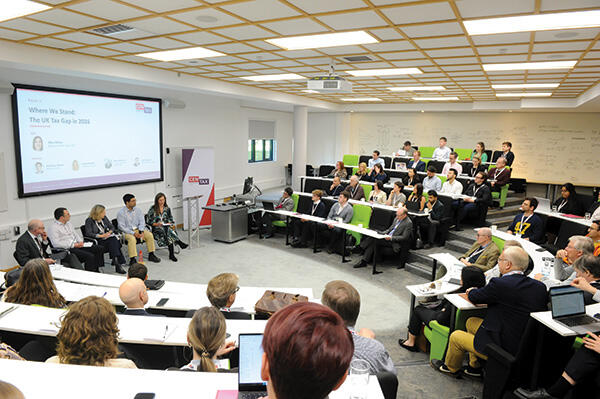
Warwick is one of our two bases, alongside the London School of Economics. Around 100 delegates joined us over the two days, drawn from HMRC and HM Treasury, major firms and independent advisers, professional bodies, UK and international academics, and think tanks. The conference aimed to broaden the debate on tax compliance in the UK by combining policy, administrative, technical, legal and academic perspectives that do not often share a room. It was great to see CIOT and ATT members contributing throughout the event.
Day one focused on understanding and measuring the tax gap, opening with a panel chaired by Ellen Milner, CIOT Director of Public Policy, which considered how the UK measures the tax gap and how its methodology compares internationally. This was followed by a keynote address from Professor Annette Alstadsæter, Director of Skatteforsk, the Norwegian Centre for Tax Research, on the global picture of offshore wealth and the limitations of official estimates.
The afternoon sessions looked at small and micro-businesses, the largest single component of the tax gap. The panel was chaired by Ele Theochari, ATT Vice President and Partner at Blick Rothenberg, and included Paul Aplin, President of CIOT, alongside Professor Judith Freedman of Oxford University and Ronan McDonald from HMRC. It proved to be one of the liveliest sessions of the conference.
The formal business of the day over, delegates gathered in The Slate for a pre-dinner reception sponsored by CIOT, where John Barnett, CIOT Deputy President, spoke a few words to attendees before the after-dinner address by Dan Neidle of Tax Policy Associates.
Day two focused on the future of tax compliance and administration. Proceedings opened with a keynote from Dr Simon Price, AI Advisor to HMRC, on HMRC’s use of AI and data in tax compliance, followed by a panel discussion on data and digitalisation. The closing panel considered how to build a long-term roadmap for closing the tax gap that goes beyond electoral cycles, with Emma Rawson, ATT Director of Public Policy, among the panellists.
Alongside the plenary programme, 12 breakout sessions gave delegates opportunities for smaller, more interactive discussions on specific aspects of tax compliance. Topics ranged from offshore evasion to the taxation of wealthy individuals, Making Tax Digital, the Taxes Management Act and HMRC’s data science capabilities. Emma Rawson led a breakout session on HMRC capacity and service standards, while Jane Mellor, Head of Professional Standards at CIOT and ATT, co-led a session on the role of intermediaries with Chris Irwin from HMRC.
Broader reflections on the conference are on the CenTax website, but four themes emerged repeatedly across the two days:
- The annual tax gap publication could be better targeted toward generating actionable insights, with deeper analysis by specific taxes, behaviours and customer groups.
- The small business tax gap comprises a range of many issues, not one, with sole traders, microbusinesses, growing companies and the cash economy each requiring different responses.
- The main constraint on the use of data and AI in tax compliance is the quality of underlying data foundations, rather than AI capability.
- Tax compliance is a coordination challenge across government, not simply an HMRC problem.
My thanks go to everyone who joined us at Warwick, and colleagues from CIOT and ATT for their contributions throughout the programme. We hope to run the conference again in two years’ time, and to see the same strong level of engagement from the tax practitioner community. If you would like to know more about our work, do feel free to get in touch.
Josh Flew
Policy Fellow, CenTax
[email protected]