



Marshmallow pies: a sticky case for VAT
Share this article



We examine a case which determines the VAT rate applicable to giant marshmallows.
Key Points
What is the issue?
A First-tier Tribunal decision considered whether ‘Mega Marshmallows’ fall within the definition of ‘confectionery’ for VAT purposes, focusing on Note (5) to Value Added Tax Act 1994 Sch 8 Group 1 and whether the product is ‘normally eaten with the fingers’.
What does it mean to me?
The case confirms that the extended statutory definition of ‘confectionery’ in Note (5) can override the ordinary meaning, and that tribunals will take a practical, evidence-based approach to questions like how a product is typically consumed.
What can I take away?
When advising on VAT liability of food, do not rely solely on everyday meaning. Carefully apply the statutory wording, especially deeming provisions like Note (5), and be prepared to analyse real-world usage to determine the correct VAT treatment.
The VAT treatment of food is a good example of how a simple, widely known tax rule is actually subject to considerable complexity and, consequently, much confusion.
For example, for a non-expert, it is hard to explain why a product manufactured by United Biscuits, which is biscuit-sized and sold in the biscuits section of most supermarkets, is actually treated as a cake. More importantly, it is hard to explain why the categorisation of such a product – a Jaffa Cake – is important only because it is covered on one side by chocolate.
Similarly, even if it can be understood that Strawberry Nesquik is a beverage that should attract the standard rate of VAT, it will be hard for a non-expert to explain why the chocolate flavour version is zero-rated.
The answer flows from the wording of Value Added Tax Act 1994 Schedule 8 Group 1. Whilst food for human consumption primarily qualifies for zero-rating, this is subject to a number of exceptions. One such exception is food supplied in the course of catering. Other exceptions apply to different types of food.
The Jaffa Cake case concerned Excepted Items, No. 2, which brings back into the scope of the standard rate any food which is ‘Confectionery, not including cakes or biscuits other than biscuits wholly or partly covered with chocolate or some product similar in taste and appearance’.
It can therefore be seen that, whereas food is prima facie zero-rated, confectionery is prima facie standard-rated. However, if the confectionery is a cake or biscuit, it is taken back out of the list of standard-rated products and accordingly qualifies for zero-rating alongside other food. However, biscuits (as opposed to cakes) that are wholly or partly covered with chocolate (or some equivalent product) do not qualify for zero-rating and are therefore treated as standard-rated (alongside other confectionery). It is that final point which made it so important for United Biscuits to show that a Jaffa Cake was a cake and not a biscuit.
However, Item 2 cannot be read in isolation. Note (5) to the Group provides that ‘for the purposes of Item 2 of the excepted items “confectionery” includes chocolates, sweets and biscuits; drained, glacé or crystallised fruits; and any item of sweetened prepared food which is normally eaten with the fingers’.
Item 2 and Note (5) have returned to the tribunals in the case of Innovative Bites Ltd v HMRC [2026] UKFTT 500 (TC).
The facts of the case
The taxpayer company is a wholesaler of a food product, known as ‘Mega Marshmallows’. Its argument is that these products do not fall within the meaning of ‘confectionery’ and therefore qualify for zero-rating.
Readers who feel a sense of déjà vu can be forgiven. The company won its appeal in the First-tier Tribunal back in 2022 ([2022] UKFTT 352 (TC)), where the tribunal decided that the Mega Marshmallows were not confectionery in the ordinary sense of the word and therefore fell outside the scope of Item 2.
The company won again when HMRC appealed against that decision to the Upper Tribunal ([2024] UKUT 95 (TCC)). However, in 2025, the Court of Appeal decided that the First-tier Tribunal had not properly applied Note (5). In particular, it concluded that ‘absent absurdity or the like, Note (5) is conclusive. If, accordingly, a product is “sweetened prepared food which is normally eaten with the fingers”, it is “confectionery” for the purposes of Item 2.’
As a result, the First-tier Tribunal’s original conclusion that the Mega Marshmallows did not fall within the ordinary meaning of the word ‘confectionery’ was not determinative. Instead, it was necessary to consider whether the product came within the extended definition, as provided for by Note (5).
The case was remitted to the First-tier Tribunal to be heard by a fresh panel.
The First-tier Tribunal’s decision
The case came before Tribunal Judge Amanda Brown KC (President), Tribunal Judge Matthew Donmall and Member Mohammed Farooq.
The tribunal noted that it was common ground that the Mega Marshmallows were ‘sweetened prepared food’. Therefore, it needed only to be determined whether the marshmallows are normally eaten with the fingers.
The tribunal agreed with the parties that ‘normally’ in this context meant more often than not. It therefore proceeded to undertake a multi-factorial assessment on all the evidence, addressed to the relevant statutory test – in this case, whether the Mega Marshmallows are ‘normally eaten with the fingers’.
In doing so, the tribunal had to consider a question as to the burden of proof. As is usually the case in tax disputes, it is for the taxpayer to show that the assessment under appeal is wrong. On that basis, the parties took the view that, if there was insufficient evidence to show that Mega Marshmallows are not normally eaten with the fingers, then the company’s appeal must fail. However, the tribunal felt uneasy about going down this route, particularly given the earlier finding (which was not to be disturbed) that Mega Marshmallows were not confectionery in the ordinary sense of the word.
Part of the difficulty was that the Court of Appeal made clear that this remitted hearing was not to be anchored by the First-tier Tribunal’s previous decision, although it was to be supplied with the same written evidence that was before the tribunal in 2022. Furthermore, neither party sought to adduce any further evidence at the remitted hearing. Accordingly, the tribunal saw no reason to depart from the findings of fact made back in 2022.
The tribunal noted that determining cases solely by reference to the burden of proof should arise only exceptionally. In most cases, it should be possible to reach a rational conclusion on the facts of the case without having to resort to the burden of proof. Only if the tribunal could not rationally decide the case one way or the other should it despatch the issue on the basis of who bears the burden of proof.
The tribunal then listed the four agreed ways of eating a Mega Marshmallow, using its own labels:
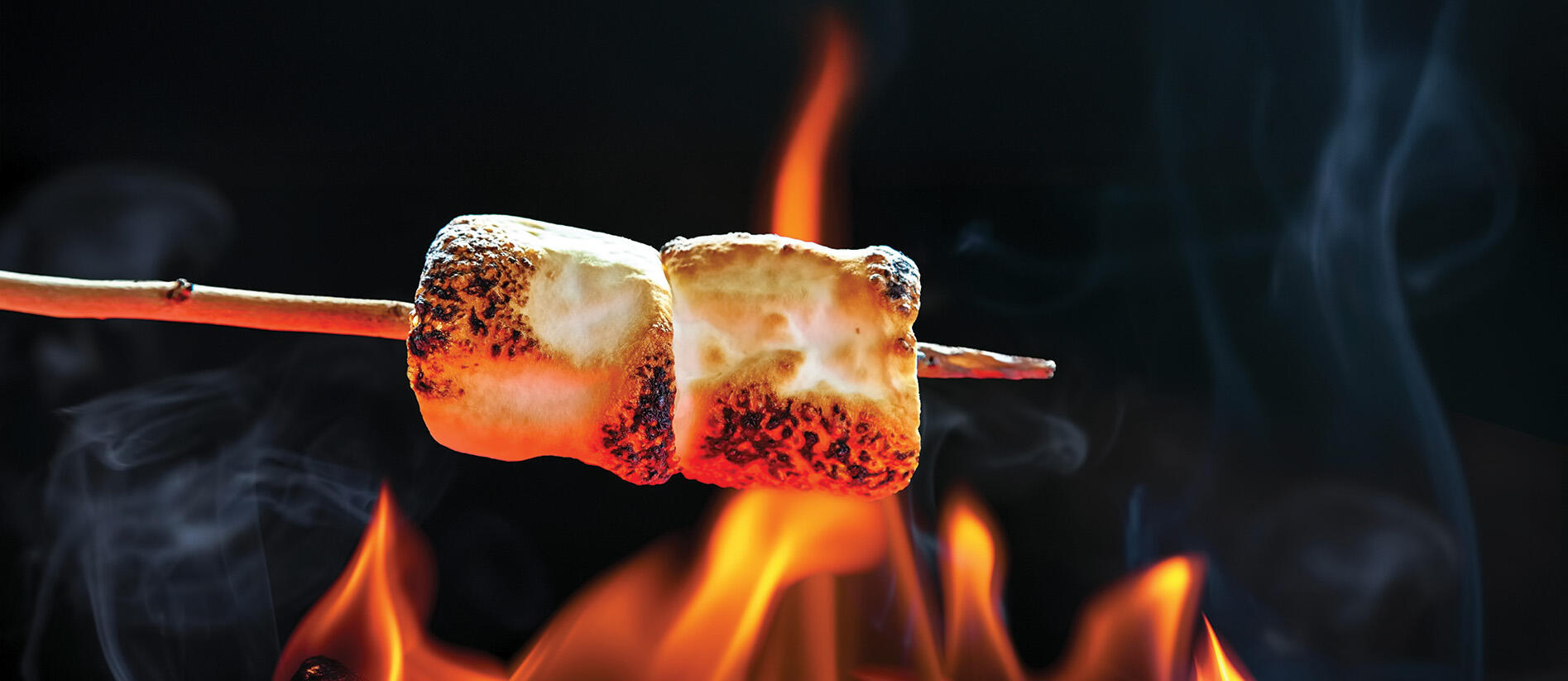
- Way A: roasted on a skewer and eaten directly from the skewer;
- Way B: roasted on a skewer, removed after having sufficiently cooled and then eaten using the fingers;
- Way C: roasted on a skewer and then inserted into the middle of two biscuits with some chocolate (the combination known as a s’more); and
- Way D: eaten straight from the pack with the fingers.
It was common ground that Way A did not constitute eating with the fingers and that Ways B and D did.
The tribunal had to resolve a dispute regarding Way C. It concluded that, when eaten as a s’more, the Mega Marshmallows are actually eaten with the biscuits (as opposed to with the fingers), even though the s’more combination itself might be eaten with the fingers. The tribunal also considered that the object being eaten under Way C is not the marshmallow but the s’more itself. For both of those reasons (taken both independently and together), the tribunal decided that Way C does not constitute the Mega Marshmallows being eaten with the fingers.
Accordingly, the tribunal then proceeded to decide whether the following mathematical notation applies (it is found in the decision itself):
(A + C) > (B + D)
The tribunal acknowledged that the evidence available to it was slight. However, it proceeded to decide that A > B and C > D. Thus, even without numbers, it was proven (mathematically and legally) that (A + C) > (B + D).
In its determination that A > B, the tribunal noted that the texture of a heated marshmallow was more suited for eating off a skewer than with the fingers.
In its determination that C > D, the tribunal noted that any individual wanting a marshmallow snack is more likely to eat a regular-sized marshmallow than a large one. In other words, the primary reason for purchasing a Mega Marshmallow is to acquire a key ingredient for a s’more.
As a result, the company’s appeal was allowed.
Commentary
Taken with the Court of Appeal’s decision, the case emphasises the importance of the provision in Note (5) and how it can override the ordinary meaning of the word ‘confectionery’.
It is worth noting that, in the Court of Appeal, Males LJ was not persuaded by the original First-tier Tribunal’s conclusion that the Mega Marshmallows were not confectionery in the ordinary sense. However, as there was no live challenge by HMRC against that part of the original conclusion, the only way HMRC could proceed was by reliance on Note (5). It will be interesting to see if HMRC chooses to rely in any future case on Males LJ’s observations as to what was apparently common ground as to the views of ‘an ordinary person’ and whether ‘such a person might well consider that it makes no difference that Mega Marshmallows are larger than ordinary marshmallows and that they are generally roasted before being eaten’.
For those interested, the Court of Appeal’s decision shows the genesis of the wording of Item 2. It is not simply a consequence of the UK joining the then European Economic Community in 1973. The rules can in fact be traced back to the Swinging Sixties and the enactment of the Purchase Tax Act 1963 (Sch 1 Part 1).
What to do next
It is too early to know whether HMRC is going to appeal against the decision. Given four hearings so far, I suspect that the taxpayer company is hoping that the case has now reached its conclusion and that HMRC’s litigators will not be asking for some more bites at the proverbial cherry (or other type of food – confectionery or otherwise).
In the meantime, this case has given tax advisers another opportunity to demonstrate that the world of tax is not entirely dry. It is undoubtedly a good case to introduce to school children about some of the work we do. It has given us plenty of food for thought.
© Getty images