

Simplyfing tax: David Gauke puts the issue in the spotlight
Share this article



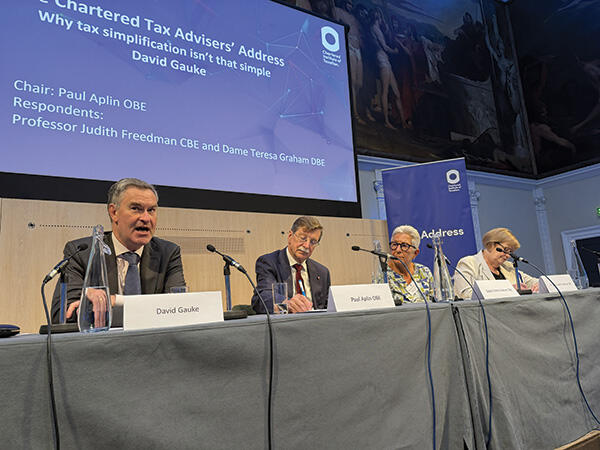
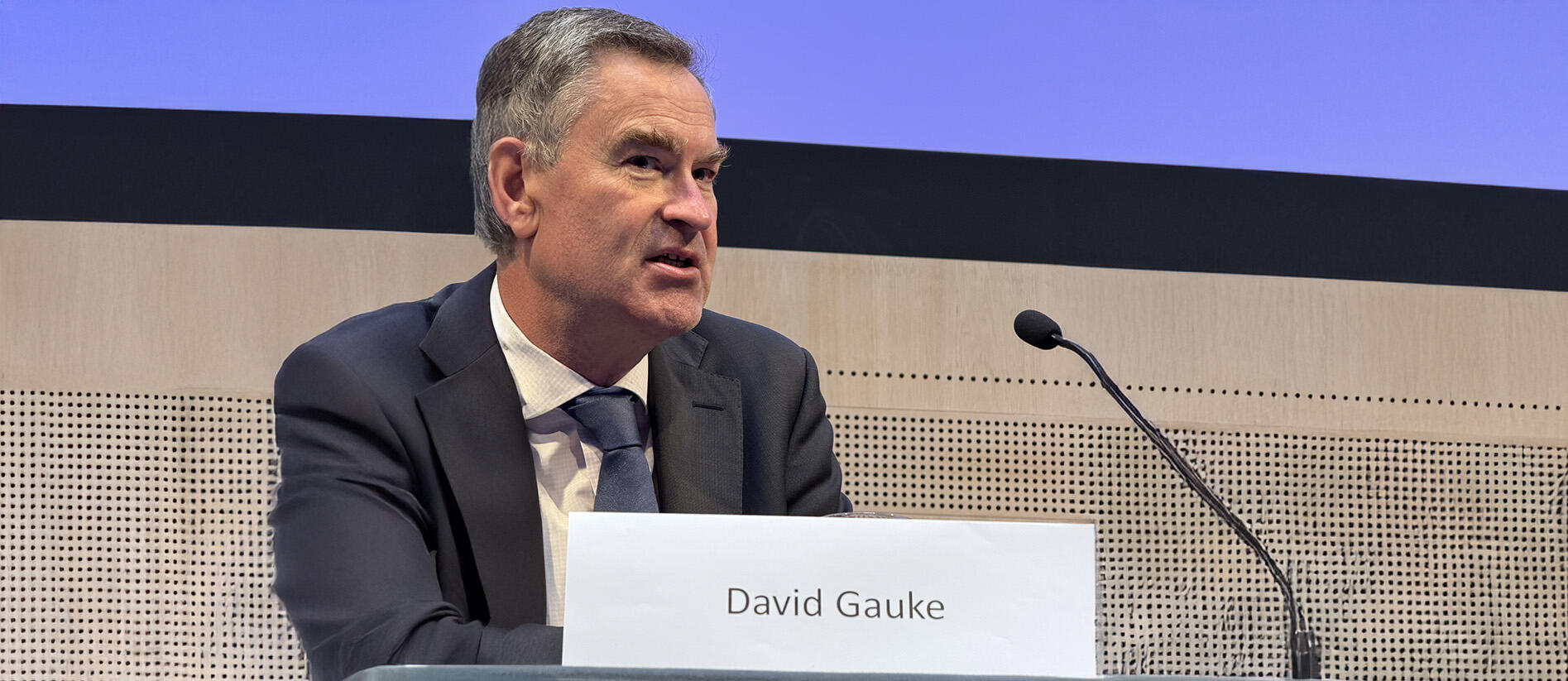
Former tax minister David Gauke put tax simplification in the spotlight at the 2026 CTA Address.
By Ghazaleh Pourzadi, External Relations Officer, CIOT and ATT
Why tax simplification isn’t that simple was the focus of the 2026 Chartered Tax Advisers’ Address, which took place on 4 June. Delivered by David Gauke, former Treasury Minister and Lord Chancellor and currently Public Policy Senior Advisor at Macfarlanes, the address emphasised the importance of simplifying the tax system, while acknowledging the difficulty of achieving it.
The CIOT President Paul Aplin chaired the session and two respondents – Professor Judith Freedman CBE, Emeritus Professor of Taxation Law and Policy in the Oxford University Law Faculty, and Dame Teresa Graham, Chair of the SME Advisory Group at UK Finance and Chair of the Administrative Burdens Advisory Board of HMRC – also contributed to the discussion.
The politics of tax simplification
In a reflective address, Gauke opened the event by revisiting his time as both shadow minister and Treasury minister, framing it as a more innocent era in politics, when the biggest problem the country faced was the VAT treatment of Cornish pasties. He used a series of anecdotes to illustrate the challenges of tax policymaking, including the so-called ‘black beer’ episode.
This related to a relief on alcohol duty that applied to black beer, a concentrated malt beverage with an original gravity exceeding 1,200 degrees. An Office of Tax Simplification (OTS) review had identified this as a suitable relief to be abolished. On the face of it, this was an easy decision but, asked Gauke, what about the one brewery that produced it and ‘all the frugal Yorkshire pensioners who enjoyed a glass of black beer diluted with milk or lemonade’? They had – after a tasting session in the Chancellor’s office – ultimately gone ahead with the abolition, but the decision had not been as straightforward as it at first appeared.
Drawing on work by Sir Edward Troup, former HMRC Permanent Secretary, Gauke identified five key aspects of tax complexity:
- lack of clarity in tax legislation language;
- length of the tax code;
- ‘excessive’ tax reliefs and exemptions;
- frequent changes and ‘meddling’; and
- structural complexity, including inconsistencies between different taxes and legal structures.
The 2012 Budget and the limits of reform
Gauke referenced the 2012 Budget, highlighting that some simplification measures, such as the removal of age-related personal allowances, had faced criticism. It was notably labelled a ‘granny tax’ by the Daily Express, though the controversy soon passed.
Other 2012 changes proved more memorable. Gauke highlighted the extension of VAT to hot takeaway food – the so-called ‘pasty tax’ – which, despite aiming to remove anomalies, was widely portrayed as ‘an attack on the working man with his love of Greggs’ hot sausage rolls’. He took away from this the lesson that there is ‘no real political reward for removing anomalies … and [it] made it harder to do tax reform after that’.
The limits of simplification and structural challenges
Although independent bodies such as the OTS contributed valuable analysis and ideas, Gauke said that they were never a ‘magic bullet’. Nevertheless, he said the decision of the then Chancellor Kwasi Kwarteng to abolish the OTS was a mistake. More fundamentally, Gauke argued that while excessive reliefs, frequent changes and structural inconsistencies are widely recognised problems, policymakers must be realistic about political constraints. In practice, ‘losers complain’ – and concentrated opposition often outweighs the more diffuse benefits of simplification.
Gauke added that maintaining discipline on simplification is difficult when chancellors are rewarded for announcing crowdpleasing measures. He cited recent cost-of-living VAT reductions for family fun activities as an example of policies that add complexity even while addressing political pressures.
Touching on structural complexity in the tax system, Gauke highlighted the differential tax treatment of employees and the self-employed. Addressing it is widely recognised as necessary to protect the tax base, but it is politically difficult because those affected bear visible costs.
Similarly, broadening the VAT base could raise significant revenue and improve neutrality, but past experience – especially the 2012 reforms – suggests that governments will be wary of pursuing such changes.
Gauke suggested that the bigger risk is VAT ‘base narrowing’. With the UK no longer constrained by EU membership, there is much greater flexibility. ‘The VAT base is a good illustration of a wider tendency in public policy to use a policy lever to solve multiple issues all at the same time,’ he observed, concluding that the result is often inefficiency.
‘Everythingism’ and political choices
Gauke warned against using the tax system to pursue too many policy objectives simultaneously. He described this tendency as ‘everythingism’ (a phrase created by Joe Hill from Re: State) – the expectation that each tax measure should address multiple goals at once. In this context, he argued that while the overall system should be progressive, not every individual tax needs to be. Policies such as zero-rating food or children’s clothing may be poorly targeted tools for achieving distributional objectives and can add unnecessary complexity.
Additionally, Gauke argued that the question ultimately is one of political choice. Governments must decide where to deploy their political capital – whether on tax simplification or alternative priorities such as planning reform, infrastructure or deregulation.
While economic logic may support simplification, we have to consider ‘the political costs, the economic benefits, and how this compares to other policy levers available to government’.
Tax administration and technology
Concluding his remarks, Gauke emphasised that for many taxpayers, the key issue is not tax policy design but administration. While improvements in systems such as self-assessment have already made interaction with the tax system easier, he was concerned about how millions of self-employed and landlords will get to grips with Making Tax Digital (MTD).
Looking ahead, Gauke believes that technology, particularly AI, could play a significant role in reducing administrative burdens and potentially even enabling new approaches to simplification. He supported many genuine efforts that have been made to make the tax system ‘simpler’, with significant contributions from tax professionals, and concluded that tax simplification does matter. However, ‘as the experience of the last few years has shown, [it] is not, unfortunately, simple’.
The response: Teresa Graham and Judith Freedman
Teresa Graham stated that simplification is a principle to support the better operation of the tax system, not an end goal. She argued that a simpler system helps taxpayers to better understand their obligations, improving compliance and confidence in the system.
Using the High Income Child Benefit Charge (HICBC) as an example, Graham highlighted how poorly designed policies can create confusion and unintended consequences. ‘The complexity, of course, arose from using the tax system to recover benefits,’ she said, adding that despite HMRC’s commitment at the time, not enough work was put into helping taxpayers understand when they might be liable for the charge.
Graham argued that where complex policies are introduced, HMRC must be adequately resourced to administer them properly. She explained that ‘HMRC’s ancient and inflexible systems don’t really allow administration to be simplified’, and systems that can process data quickly can transform the taxpayer experience while improving compliance.
Judith Freedman stressed that, despite efforts by many, including think tanks and academics, the UK still does not have a simple tax system. She praised the work of the OTS, noting that the more valuable and impactful its work became, the more it attracted criticism (particularly with its capital gains tax paper).
She described the OTS’s ‘excellent’ tax simplification review paper as a ‘suicide note’, because it stated: ‘This report recommends that the principle of simplification should be embedded in the general tax policy making process.’ Thus, it signed its own death warrant. Freedman said the focus should now turn to embedding simplification ‘in-house’ following the OTS’s abolition, but she was concerned that, particularly since the 2025 tax policy-making principles paper, simplification no longer appears to be treated as a major objective.
Freedman also emphasised the importance of consultations in designing workable tax policy, suggesting that engagement should extend beyond stakeholders and professional groups to a wider audience. She highlighted the potential for technology to support simplification, but raised concerns about MTD, observing that ‘layering a system, a technological system on top of an imperfect system doesn’t seem to be the right way around’.
Audience questions and contributions
During the Q&A session, Paul Aplin suggested that Tax Information and Impact Notes (TIINs) could have a greater role in assessing and communicating simplification impacts. Dan Gallon of the Association of British Insurers said that the priority should be to stop adding new layers of complexity, citing pensions taxation as an example.
The OTS’s first director, John Whiting, provided the example of the blind person’s allowance as an illustration of the difficulty of tax simplification. He said that the OTS suggested abolishing the relief – which has low uptake – and replacing it with a direct, better-targeted grant administered by local councils. Although this approach was supported by charities and aimed to deliver more effective support, it faced two barriers. First, it was politically unviable, as ministers were unwilling to be seen removing a benefit for vulnerable groups. Second, the proposed alternative would have significantly increased costs, leading to resistance from the Treasury.
Barrister Keith Gordon asked whether the government should have stuck to its guns on the ‘pasty tax’. Gauke responded that the priority should be on establishing ‘good tax policy’, noting that policymakers often select their battles. He reiterated a point made earlier by Freedman about the importance of prioritising the most important issues.
Edward Troup observed from the floor that the OTS was created to focus on simplification, but it had concluded that simplification works best when embedded within policymaking rather than handled separately. He said that effective simplification must align ‘good politics, good economics and good policy’. Could the panel think of anything that fitted the bill? Gauke suggested if anything did, it would surely already have been done.
Chris Sanger of EY suggested building review mechanisms into Finance Bills to revisit and improve recent legislation. Former CIOT President Peter Rayney wondered about the extent to which tax policymaking takes account of likely behavioural responses. Andy Richens, formerly of the OTS, drew attention to follow‑up work he is carrying out independently of the OTS’s ‘competitiveness review’.
You can watch the debate at: tinyurl.com/9wvrwjve