



The new CTA qualification: changes from 2028

Share this article



The 2028 CTA qualification adds staged learning, modern assessments, a greater focus on ethics and professional skills.
Key Points
What is the issue?
CIOT has reviewed the CTA qualification to ensure that it keeps pace with change and is right for the tax adviser of the future.
What does it mean to me?
Chartered tax advisers will need to have training in different skills, such as in tax technology. From 2028, the CTA qualification will further embed skills assessment and ethical practice.
What can I take away?
A response to the consultation held by the CIOT in Spring 2025 has been published, together with a detailed CTA Qualification Handbook for 2028 onwards.
In the ever-evolving landscape of UK taxation, the Chartered Tax Adviser (CTA) qualification has signalled technical excellence and professional integrity. Yet nothing stays the same forever, with technological advances accelerating the pace of change. As the tax environment evolves, the CIOT recognises that the CTA qualification must also adapt to remain relevant and robust.
In the autumn of 2023, the CIOT therefore embarked on a comprehensive review of the CTA qualification. After carrying out initial stakeholder research and reviewing internal data, a wide-ranging 12 week public consultation was launched in April 2025 to gather views from across the profession. We are grateful to all of those who took time to respond and to engage in constructive dialogue.
The CIOT has now published:
- a response document to the consultation;
- the new CTA Qualification Handbook;
- detailed syllabus grids; and
- an initial table of exemptions.
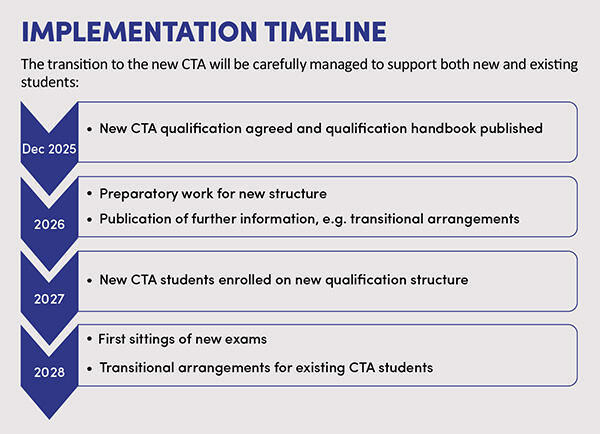
The revised CTA qualification structure will take effect for students enrolling from September 2027, with the first exam sittings in 2028. Transitional rules will be put in place for those registering for the CTA in the meantime.
This article explores how the consultation process shaped the final proposals, what has changed from the proposal published for consultation, and what the new CTA will mean for students, employers and the wider tax community.
The consultation
The CIOT’s review was a genuine invitation for stakeholders to help to shape the CTA qualification for the future. Between April and June 2025, the CIOT sought feedback on a draft new structure for the CTA, including a staged qualification model, a new Professional Skills and Competencies Framework and modernised assessment methods in some areas.
The consultation was publicised widely through the CIOT website, social media, member mailings and a well-attended live webinar. It ultimately drew 77 formal responses from a diverse array of stakeholders: students, members, employers (from small practices to the Big Four), training providers, government bodies and more.
The engagement was impressive not just in numbers, but in the depth and quality of feedback. Respondents brought a wealth of experience and a range of views on the challenges and opportunities facing the tax profession. Their input was instrumental in shaping the final proposals, and the CIOT’s response document acknowledges the areas of consensus and some points of contention. The process sought to maintain CTA’s rigour while ensuring it remains relevant to a changing profession.
How the CTA is changing
1. The staged qualification
At the heart of the new CTA is a staged qualification structure, designed to support progressive learning and to make the pathway to qualification accessible and flexible. The new model comprises three stages.
Although the CIOT is not regulated by Ofqual, for the purposes of reviewing the qualification we have benchmarked each stage to the Regulated Qualifications Framework levels. This gives clarity over the standard of the qualification (with the final Level 7 of the CTA being the equivalent of a Master’s degree). The three stages are:
- Foundation (Level 5 equivalent): An on-demand, objective-test assessment providing a broad introduction to UK taxation for those without prior experience.
- Technical knowledge and skills (Level 6 equivalent): A suite of six technical modules of which candidates must sit five. These are divided by tax topic as opposed to specialism, with Income Tax and NIC being compulsory. There will also be a new Tax Landscape skills paper, in a case study format. Technical knowledge will not be a key element of this paper as it is skills-focused, but underpinning tax knowledge will be drawn from the compulsory Tax Knowledge module. Overall, this stage bridges the gap between foundational knowledge and specialist advisory work, preparing candidates for the final stage. Employers welcomed that the revised qualification will embed ethics in practice; for example, by incorporating this topic within the new skills paper.
- Advisory (Level 7 equivalent): A single Advanced Technical paper and an Application and Professional Skills case study in a chosen specialism.
This structure was broadly welcomed by respondents to the consultation, who saw value in a more gradual development of knowledge and skills. The introduction of a Level 6 equivalent stage was seen as a way to support candidates who might otherwise struggle with the leap straight to the Level 7 (Master’s degree equivalent) assessment.
While generally respondents noted the benefits of a progressive structure, some were worried that the inclusion of a Level 6 equivalent stage, coupled with a reduction in assessment hours at Level 7, might be perceived as lowering the overall standard of the CTA. The CIOT’s response to such concerns is that, while the distribution of assessment hours is changing, the qualification as a whole remains benchmarked at the equivalent of Level 7, and the final standard is therefore undiminished.
It is worth noting for comparison purposes that the same progressive principle to be used in the future CTA is widespread in other qualifications: for example, a university Bachelor’s degree culminates at Level 6, but earlier stages build knowledge and skills capability towards this eventual final assessment.
2. Recognition at Level 6: more consideration required
One of the more debated proposals was whether to offer formal recognition for candidates who complete the Level 6 equivalent stage but who do not then progress to full CTA status. While some respondents saw this as a way to enhance accessibility and reward partial achievement, others feared that it would create confusion around the CTA designation and dilute its value.
The CIOT has decided not to proceed with this idea at present, but will keep the proposal under review. Instead, the focus will be on making the qualification more flexible, such as by reviewing the expiry rules for exam passes. The CIOT will look at the possibility of removing these requirements and replacing them instead with limits on the number of attempts, possibly supported by student membership and continuous professional development requirements.
3. Breadth versus specialism: striking the right balance
Perhaps the most contentious issue in the consultation was the balance between breadth and specialism. Should the CTA require all candidates to develop a broad base of tax knowledge, or should it allow earlier and deeper specialisation?
The feedback we received was mixed, often reflecting the size and focus of the respondent’s own area of practice. Some, especially from larger or more specialist firms, argued for the option to specialise earlier. Others believed that breadth of knowledge is essential for producing well-rounded advisers.
The CIOT’s decision is to retain the requirement for broad tax knowledge, with limited choice at the Technical Knowledge stage and specialisation being reserved for the Advisory stage. The qualification will, however, be kept under annual review, with the possibility of introducing further specialisms in the future. The CIOT will also be looking at developing additional complementary post-CTA qualifications in specialist areas such as human capital taxes.
4. Assessment methods: modernisation and accessibility
A key theme of the consultation was the need to modernise assessment methods and improve accessibility. The new CTA will feature:
- On-demand assessment at the Foundation level: This was strongly supported as a way to fit study around work and personal commitments, and to allow faster progression (or resits) where needed.
- Flexible module sittings at the Technical Knowledge stage: Candidates will be able to sit modules individually, in groups or all together, according to their circumstances and employer preferences.
- Case study-based assessment for skills papers: The new Tax Landscape and Application and Professional Skills papers will use case studies, with pre-seen information to allow for more realistic, workplace-relevant assessment.
- Open book exams (with limits): While there was overwhelming support for open book assessments, there was no consensus on how wide the access to resources should be. The CIOT has decided to allow access to approved resources (legislation, HMRC guidance and possibly study manuals), but not to give full internet access or permit the use of AI tools. This strikes a balance between realism and fairness.
5. Professional Skills and Competencies
The introduction of a new Professional Skills and Competencies Framework was widely welcomed as a way to define and benchmark the skills expected of a CTA. The framework covers not just technical knowledge, but also research, analysis, communication, ethical conduct and the use of technology (including AI).
There was more debate about the proposal to introduce a mandatory ‘light touch’ training log. While many saw this as a truer reflection of competence than a simple ‘time served’ requirement, concerns were raised about administrative burden and the challenges of verification, especially for self-employed candidates.
The CIOT will adopt the Professional Skills and Competencies Framework as a standard, but further consideration will be needed before any new requirements are introduced. For now, the Framework will be helpful as a tool for students and employers to understand the potential of the Chartered Tax Adviser designation, and it is being used as a tool to help develop continuous professional development activities.
6. Other notable changes and clarifications
- Indirect Tax specialism: The Advisory-level Indirect Tax syllabus will focus on VAT and Customs Duties, with Customs Duties examined only at the Technical Knowledge stage.
- Human Capital Taxes: The option to specialise in Human Capital Taxes at Advisory level will be discontinued. However, the CIOT will work towards introducing a complementary post-CTA qualification in this specialist area.
- Reduction in Advanced Technical papers: The number of Advanced Technical papers at Advisory level is reduced from two to one, with the option for post-qualification certification in additional specialisms. This means that if, for example, a student had sat the Individuals Advanced Technical paper as part of their CTA qualification, they might choose to sit another paper (such as Owner-Managed Businesses) to gain post-qualification certification in this area. Respondents felt this could be helpful in some circumstances; for example, on looking to move into a different area of specialism.
- Administrative improvements: Many respondents gave feedback on the existing software used in the CTA examinations, with requests for improved functionality. Since the consultation, the CIOT has announced that a new software provider will be used from November 2026, with enhanced features such as use of native Word and Excel in answering questions.
A note on the ACA/CTA and CA/CTA joint programmes
One query raised during the consultation related to how the ACA/CTA and CA/CTA joint programmes – which the CIOT runs with the ICAEW and ICAS respectively – will be impacted by the changes to the new qualification.
Many readers will be aware that these joint programmes were already redesigned in 2025. The changes made to them were implemented with a view to being complementary to the proposed new CTA structure. There will therefore be no further changes, except that alterations to the syllabuses for the optional Advanced Technical and Application and Professional Skills papers will apply for joint programme candidates sitting them from May 2028 (in the same way as they will apply for all CTA students).
The new CTA in detail: structure and syllabus
The new CTA, as set out in the 2028 Qualification Handbook, is designed to be both rigorous and flexible, supporting a diverse range of candidates and career paths.
Stage 1: Foundation (Level 5 equivalent)
- Aim: To provide a broad introduction to UK taxation for those new to the field.
- Modules: Foundation Tax paper covering key aspects of Income Tax, Inheritance Tax, Chargeable Gains, Corporate Taxes, VAT, Stamp Taxes; plus separate papers in Accounting, Law and Ethics.
- Assessment: On-demand, objective-test questions (for example, multiple choice), auto-marked for efficiency.
Stage 2: Technical Knowledge and Skills (Level 6 equivalent)
- Aim: To develop essential technical knowledge across a range of tax areas, prior to specialisation, and to enable candidates to develop research, analysis and application skills.
- Tax Knowledge modules: Compulsory Income Tax and National Insurance, plus four electives from: Inheritance Tax, Trusts and Estates; Chargeable Gains and Stamp Taxes; Corporate Tax; VAT; and Other Indirect Taxes.
- Skills Paper: The new ‘Tax Landscape’ module, focusing on research, application, ethics, dispute resolution and the use of technology.
- Assessment: Tax Knowledge will be comprised of written exams (a mix of short and long-form questions), with flexible module sittings. Tax Landscape will be a case study with pre-seen information enabling research in advance of the examination.
Stage 3: Advisory (Level 7 equivalent)
- Aim: To develop deep expertise in a chosen specialism and the ability to apply knowledge in complex, real-world scenarios.
- Specialisms: Taxation of Individuals; Inheritance Tax, Trusts and Estates; Owner-Managed Businesses; Larger Companies and Groups; and Indirect Taxation.
- Assessment: One Advanced Technical paper (written exam) and one Application and Professional Skills case study (with pre-seen information).
- Flexibility: Candidates may choose to sit their Application and Professional Skills paper in a different specialism from their Advanced Technical paper, if desired.
A qualification for the future
The new CTA qualification represents a significant evolution, balancing the need for breadth and depth in tax knowledge, modernising assessment and enhancing accessibility. It is the product of extensive consultation and careful deliberation, reflecting the views and values of the profession it serves.
The CIOT looks forward to continuing to work closely with stakeholders as we move towards the launch of the new structure – and indeed beyond – as we work on a programme of regular review and continuous improvement into the future.
© Getty images