



US limited liability companies: caught between two systems

Share this article



US LLCs can create significant double taxation for UK residents, but proposed reforms could align the two countries’ tax treatment.
Key Points
What is the issue?
US LLCs are generally treated as transparent for US tax purposes but opaque in the UK. This mismatch can result in the same underlying income being taxed differently, producing effective tax rates of over 70%.
What does it mean to me?
UK resident individuals with US LLCs may face significant double taxation, with limited foreign tax credit relief. Advisers need to understand how the LLC is classified and the consequences of receiving or deferring distributions.
What can I take away?
The government is considering reforms that could align UK taxation more closely with overseas treatment, potentially reducing double taxation. However, important questions remain over elections and transitional rules, so advisers should watch developments closely.
US limited liability companies (LLCs) are widely used by US resident individuals for business, investment and personal purposes. However, they can create significant tax problems when their owners become UK resident.
Where an individual with an interest in an LLC is taxable in both the US, due to residence or citizenship, and in the UK, the two countries can treat the same entity and its income differently. This can result in high effective tax rates, with little or no relief from double taxation.
The government has consulted on reforming the taxation of UK resident individuals with interests in US LLCs and other ‘reverse hybrids’. HMRC is currently analysing responses before publishing the consultation outcome. Changes may therefore be on the horizon, although there is not yet a date for when any changes would take effect.
Why Americans use LLCs
US LLCs are widely used by US residents for both business and personal matters. They may be used as a business entity or investment structure, as well as for privacy and asset protection. They can also offer administrative advantages, including ease of set-up and limited annual filing requirements, and tax efficiencies arising from their transparent tax treatment in the US.
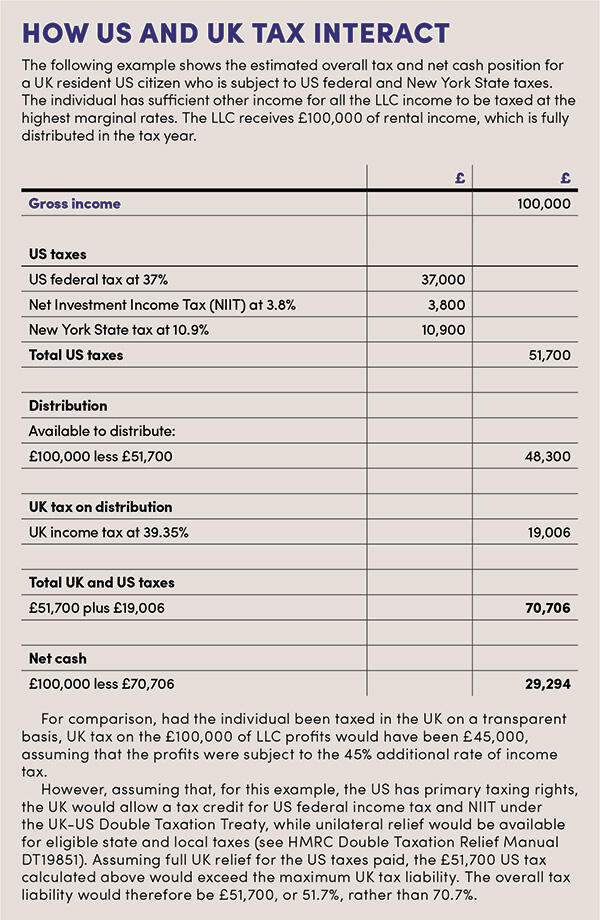
Americans who come to the UK, or are considering doing so, may therefore already have LLCs within their business, investment or personal asset structures. However, mismatches between the US and UK tax systems can result in an effective tax rate of over 70% when US federal, state and local taxes and UK taxes are taken into account.
The US-UK tax mismatch
The mismatch arises because the UK and US generally treat LLCs differently for tax purposes. In the US, LLCs are transparent by default: where an LLC has a sole owner, its income and expenses are generally treated as those of the owner directly (known as a ‘disregarded entity’), while an LLC with multiple owners is generally treated as a partnership. An election can instead be made for corporate tax treatment.
Where an LLC is treated as disregarded or as a partnership, its income is attributed to its owners regardless of whether corresponding distributions are made to them during the tax year. In the UK, by contrast, LLCs are typically treated as opaque, meaning that they are treated as corporations and UK resident individuals pay tax on distributions they receive as though they were dividends.
This means that the two countries determine the taxable income, and the timing of that income, under very different sets of rules. Relief from double taxation is limited, with foreign tax credits available only in a small number of situations where the type and timing of income align sufficiently closely. Double taxation can therefore arise even though, economically, the same underlying income is being taxed in each country.
The US tax position
The default transparent nature of LLCs means that, for US tax purposes, all income and expenses flow through to the owners of the entity. Where there is more than one owner, partnership tax rules apply. This means that where a US citizen residing in the UK owns an income-producing LLC, they must report the net income on their annual US income tax return and pay tax, regardless of whether that income is distributed or reinvested in the LLC. Similarly, non-US persons who use an LLC to own rental property or businesses in the US are subject to annual US tax filing requirements and tax on the income arising within the LLC.
The highest marginal US federal tax rate that may apply to individuals is 37%, or 20% on long-term capital gains and qualified dividends. For US citizens and residents, an additional 3.8% Net Investment Income Tax (NIIT) may also apply at the federal level, resulting in a possible top US federal tax rate of 40.8% on investment income.
Depending on where activity occurs within the LLC, or where the owners reside, state and local taxes may also apply. For example, individuals subject to New York State tax may pay up to an additional 10.9% tax (where income exceeds $25 million) on net income arising from New York activities. The applicable income tax rate depends on the type of income and the individual’s total income. For example, where an individual earns net rental income via an LLC from property located in New York State, the total top marginal tax rate may be as high as 51.7%.
Where the owners of the LLC have elected to treat it as a corporation for US tax purposes, the entity itself is subject to corporate income tax rates at the federal and state levels. Distributions from an LLC that has elected corporate status are treated as dividends and subject to tax when issued to the owners of the LLC.
The UK tax position
For UK tax purposes, whether an LLC is transparent or opaque depends on its legal documents and the applicable US state law.
HMRC’s view is that ‘almost all’ US LLCs are opaque for UK tax purposes. See HMRC’s International Manual INTM180030 for the foreign entity classification guidance and the recent ‘Consultation on reform to taxation of UK-resident members of LLCs and other reverse hybrids’ (see tinyurl.com/b2xazfh2) for an explanation of ‘almost all’. In our experience, HMRC sets a high bar for accepting that a particular US LLC is transparent for UK tax purposes. Where a US LLC is treated as opaque for UK tax purposes, UK resident individuals can pay income tax at up to 39.35% on distributions received from the LLC.
UK tax on a transparent basis
The UK does not currently allow taxpayers to choose whether an entity should be taxed as transparent or opaque. UK resident individuals are therefore unable to make an election for an LLC to be taxed transparently in the UK, as they can in the US.
A UK resident individual may nevertheless be taxed on the income and gains of a legally opaque LLC as they arise where UK antiavoidance legislation applies. This includes the transfer of assets abroad provisions for income tax and the Taxation of Chargeable Gains Act (TCGA) 1992 s 3 for capital gains tax. However, these provisions only apply if there is a UK tax avoidance motive and, in practice, Americans typically have LLCs in place for business or personal reasons rather than UK tax reasons.
In practice, HMRC commonly accepts that there is no UK tax avoidance motive and that the anti-avoidance provisions therefore do not apply. UK resident individuals must instead pay tax on distributions received, without relief for US taxes paid on the underlying income and gains.
This unusual circumstance, in which a taxpayer may prefer to pay tax under anti-avoidance provisions, arose in Anson v HMRC [2015] UKSC 44. The taxpayer could not choose to opt out of the motive defence, with the result that the anti-avoidance provisions did not apply and no relief was available for US taxes paid.
Practical impact
The high effective tax rate can affect the behaviour of UK resident individuals with LLCs. Responses we encounter include:
Changing the legal documents: In some cases, it is possible to change the legal documents so that the LLC is transparent for UK tax purposes. However, this is often not feasible for business, personal or US tax reasons. As HMRC expects ‘almost all’ LLCs to be opaque, it can also be difficult and time consuming to agree with HMRC that a given LLC is transparent for UK tax purposes.
Not making distributions: Individuals may decide not to receive distributions while UK resident, so that UK tax does not arise and only US tax applies. In some cases, this can mean that Americans spend less in the UK than they otherwise would have done.
Making distributions while the foreign income and gains (FIG) regime for new arrivers applies: This may be feasible where funds have already accumulated and are readily available for distribution. However, not everyone will be able to receive distributions during the four-year FIG period. The LLC may not have funds available for distribution, or the business may be in a growth phase requiring funds to be reinvested for a set period or until specified metrics are met.
Not moving to the UK: Americans with LLCs may decide not to move to the UK because of the high effective tax rate or the perceived complexity of the tax position. These considerations are relevant both to individuals and to their advisers, who may not include the UK among the jurisdictions they recommend when clients are considering where to move.
Consultation on changing the UK tax rules
Against this background, in summer 2026 the government held a consultation on the taxation of UK resident individual members of US LLCs and other reverse hybrids (see ‘Consultation on reform to taxation of UK-resident members of LLCs and other reverse hybrids’ at tinyurl.com/bdfx4d5s).
The consultation document focuses on high effective tax rates that arise for individuals due to entity classification mismatches between the UK and overseas jurisdictions. US LLCs are given detailed consideration and views were sought on the impact of these high effective tax rates on individuals and businesses, as well as on proposals to change the legislation to mitigate the issue.
Several proposals were put forward. One is to tax UK resident individuals with interests in overseas entities in a way that matches the tax treatment in the overseas jurisdiction. For US LLCs that are transparent in the US, this would mean taxing UK resident individuals on the income and gains of the LLC as they arise, whether or not any distributions are received, but with the potential for relief from double taxation through foreign tax credits or treaty relief where applicable. For many US individuals, this could be simpler than the present system and could result in a lower overall effective tax rate across the two jurisdictions.
There are important details still to work out in relation to the proposals, including:
- whether taxpayers should be taxed in the same way as in the overseas jurisdiction automatically or only where an election is made; and
- transitional rules, both on the introduction of the new rules and where there is subsequently a change in tax position. This could include, for example, an individual who already owns a US LLC becoming UK resident, or a change in the tax treatment in the overseas jurisdiction.
While these points of detail are important, the headline proposal to make the taxation of US LLCs and other foreign entities simpler, while reducing the potential for double taxation, is a positive direction of travel.
Conclusion
It is common for Americans to have US LLCs for a variety of personal and business reasons. The mismatch between the UK and US tax treatment, and the resulting high effective tax rates and differing reporting requirements, can discourage Americans from moving to the UK or remaining here long term.
Reform that simplifies the tax treatment and reduces the potential for double taxation could therefore make the UK more attractive to Americans considering relocation, although the detail of any changes will be important.
© Getty images