



Where there’s a will: the cost of poor drafting

Share this article



Poorly drafted or outdated wills can create unexpected inheritance tax liabilities, but early intervention may preserve reliefs and improve outcomes.
Key Points
What is the issue?
Poorly drafted or outdated wills can undermine inheritance tax planning because inheritance tax follows the legal effect of the will rather than the testator’s intentions.
What does it mean to me?
Common drafting issues involving charitable gifts, discretionary trusts, residuary clauses and the residence nil rate band can create unexpected tax liabilities and alter who ultimately benefits from an estate.
What can I take away?
Review the will as early as possible in any estate administration. Identifying drafting issues promptly may allow corrective action through remedies such as deeds of variation before valuable planning opportunities are lost.
There is a familiar point in many estate administrations where the tax analysis appears straightforward. On paper, the deceased’s estate looks manageable. Asset values are known, reliefs appear available and the inheritance tax position can be assessed with reasonable confidence.
When the will is examined in more detail, things can start to unravel. A surprisingly high number of estates suffer avoidable tax not because the family is wealthy, but because the will is outdated, unclear or poorly drafted. Years of sensible planning can be undermined by wording that does not achieve the intended legal effect.
From a private client perspective, many of the most expensive tax outcomes are not driven by wealth, but by wording. The most problematic estates are often not the largest or most complex but those where the drafting does not achieve the intended result. Small defects when the will is signed can go unnoticed for years, yet produce significant consequences when they are finally tested after the testator’s death.
Inheritance tax applies to what happens in law, not what was intended. If a will does not operate as expected, the tax treatment follows the legal outcome. A family may assume that a surviving spouse will inherit, only to discover that the wording does not achieve spouse exemption as expected. A charitable gift may fail, a property may not qualify for relief because of the ownership structure, or a seemingly simple will may produce an unexpectedly complex tax result.
For tax advisers, the key skill is recognising when the outcome is being driven by drafting rather than value. During lifetime, poor drafting can often be corrected by a new will. After death, the available options are narrower, time limited and usually more expensive. Executors may need to submit inheritance tax returns before legal uncertainties are resolved. Interest can accrue on unpaid tax, assets may be frozen pending legal advice and beneficiaries may disagree about how the estate should be administered.
If the tax result looks surprising, it is often because the will is not operating in the way everyone assumed.
Failed charity gifts: losing exemption and rate reliefs
Charitable legacies are often included in wills for both philanthropic and tax planning reasons. However, they are also one of the areas most vulnerable to drafting errors.
Most advisers are familiar with the inheritance tax exemption for gifts to UK-registered charities. Many will also be aware that where at least 10% of the baseline amount of an estate passes to charity, the reduced rate of inheritance tax under Inheritance Tax Act 1984 Sch 1 applies, reducing the rate from 40% to 36%. This is covered in depth in Inheritance Tax Manual IHTM45000 and is well understood by most practitioners. What is less widely appreciated is how often charity clauses fail in practice.
The problem is rarely the intention. More often, it is the drafting. The charity may be incorrectly named, the organisation may have merged or rebranded since the will was prepared, the wording may be too vague to identify the intended recipient, or the gift may be subject to conditions that cannot be satisfied. Another issue to watch for is asking the executors to give 10% to charity and then sending a letter of wishes to them. This is too vague to qualify.
Case study: Misdescribed charity
Justine’s homemade will included a legacy of £300,000 to ‘the Macmillan nurses’. The executors could not determine whether the gift was intended for individual nurses employed by a local cancer unit, a local service operating under the Macmillan name, or Macmillan Cancer Support itself. There were no attendance notes, letters of wishes or other records capable of confirming Justine’s intention.
The executors hoped the issue could be resolved through Counsel’s Opinion. Unfortunately, the uncertainty could not be resolved and the gift failed into residue.
The tax consequences were significant. The estate lost the inheritance tax exemption that would otherwise have applied to the £300,000 gift, thus creating additional inheritance tax exposure of up to £120,000. More significantly, the failed legacy meant the estate no longer met the 10% charitable threshold required for the reduced 36% rate, increasing the overall inheritance tax burden still further.
Where a charity clause appears uncertain, it is worth verifying the position before relying on the exemption. In practice, advisers should compare the inheritance tax liability if the gift fails, the liability if the gift can be redirected effectively to charity, and whether the reduced-rate provisions can still be preserved. The difference can often justify early intervention.
Discretionary trusts: when structure overrides intention
What was regarded as sensible planning in 2006 may be inefficient in 2026.
Many older discretionary trust wills were drafted for a very different inheritance tax landscape. Before the introduction of transferable nil rate bands in October 2007, discretionary trust structures were frequently used to preserve inheritance tax allowances, while also providing flexibility and a degree of asset protection for future generations. Some continue to work well. Others no longer achieve the outcome that the testator intended.
A discretionary trust differs fundamentally from an outright gift. Rather than giving assets directly to a beneficiary, the trustees decide which beneficiaries should benefit, when and to what extent. That flexibility can be valuable, but poor drafting can also create unexpected tax consequences.
The distinction is particularly important where a surviving spouse is involved. An outright gift to a spouse will normally qualify for spouse exemption and pass free of inheritance tax on first death. Certain immediate post-death interest trusts can achieve a similar result. A discretionary trust may not. From a family perspective, a spouse may appear to have been provided for under a discretionary trust. From a tax perspective, however, the legal structure can produce a very different outcome.
Problems arise where the drafting does not accurately reflect the testator’s intentions. A trust intended to create a life interest for a spouse may instead be drafted as discretionary, or the trustees’ powers may be drawn more widely than intended.
Case study: Assumed spouse provision
Ahmed’s will left an estate worth approximately £850,000 ‘to my trustees for the benefit of my spouse and children as they shall in their discretion decide’. The family assumed that this provided fully for Ahmed’s surviving spouse. In reality, the spouse had only a potential benefit under the trust rather than an automatic entitlement to the assets.
That distinction proved important. The trust did not produce the inheritance tax outcome the family had expected and created additional complexity from the outset. There was an immediate inheritance tax exposure on first death and the trust entered the relevant property regime, bringing with it ongoing administration, potential ten-year and exit charges, and the possibility of restricting future reliefs, including the residence nil rate band.
The lesson is simple. Where a discretionary trust appears in an older will, the tax position should never be assumed to mirror an outright gift to a spouse. It is worth revisiting the underlying planning assumptions before taking the inheritance tax treatment for granted.
Residuary clauses and partial intestacy
The residuary clause is often the most important provision in a will. It determines who inherits everything left in the estate after debts, expenses, taxes and specific gifts have been dealt with. Where the clause does not operate as intended, all or part of the estate may pass under the intestacy rules instead.
Problems can arise for surprisingly simple reasons. A residuary beneficiary may die before the testator without a substitute beneficiary being named. Shares may not add up correctly. A gift of residue may be uncertain, or a later homemade amendment may conflict with the original wording. When that happens, assets can pass to people the testator never intended to benefit and carefully planned inheritance tax outcomes can quickly unravel.
Case study: The broken residue clause
This concerned the second marriage of Jean and Alex.
Jean had adult children from a previous relationship and Alex, who had no children of his own, treated them as his family. Alex left his estate to Jean on the assumption that she would survive him and, ultimately, pass the assets to her children.
The will did not contain a substitute provision if Jean died first.
Tragically, she was killed in a car accident. Alex inherited her estate but subsequently lost capacity and was unable to update his own will. When he died a year later, the combined estates passed under the intestacy rules to Alex’s brothers and sisters from whom he had been estranged for many years. The stepchildren he had intended to benefit received nothing.
The tax consequences followed the legal outcome. Assumptions about spouse exemption and residence nil rate band planning no longer held true and the overall inheritance tax liability increased.
The lesson is that residuary clauses should always be tested against real-life contingencies, particularly in blended families and second-marriage situations where the consequences of a failed gift can be especially severe. If the residue clause fails, the tax planning often fails with it.
The family home and the residence nil rate band
The residence nil rate band (RNRB), which can provide up to £175,000 of additional inheritance tax relief where a family home passes to direct descendants, remains one of the most frequently lost reliefs. In many cases, the intended beneficiaries are exactly the people the legislation was intended to benefit, but the structure through which they inherit prevents the relief from applying.
The difficulty is that the relief depends not only on who inherits the property, but how they inherit it. To qualify, the property generally needs to be ‘closely inherited’ by direct descendants. Where a family home passes through certain trust structures, that requirement may not be met.
This issue arises regularly in older wills that were drafted before the introduction of the RNRB in April 2017. A structure that appeared sensible at the time may inadvertently restrict relief that did not exist when the will was prepared.
Whenever a family home forms part of the estate, advisers should look beyond the identity of the beneficiaries and consider the mechanism of inheritance. A gift to children or grandchildren may not achieve the expected result if the property passes through the wrong trust structure or if the entitlement is subject to conditions that prevent the statutory requirements from being satisfied.
Case study: Property passing via a trust
Margaret’s will left her family home, worth approximately £700,000, to a discretionary trust for the benefit of her children and grandchildren.
From a family perspective, the arrangement appeared entirely sensible. The property was ultimately intended for the next generation and the trust provided flexibility over how and when benefits could be distributed. From a tax perspective, however, the position was less favourable. Because the property was not ‘closely inherited’ by direct descendants in the manner required by the legislation, the estate was unable to claim the residence nil rate band.
Similar issues can arise where a gift to children or grandchildren is contingent on them reaching a specified age. While such provisions are often included for entirely sensible family reasons, they can prevent the property from being treated as ‘closely inherited’ for residence nil rate band purposes. As a result, a family home may ultimately pass to the intended beneficiaries but still fail to qualify for relief, increasing the inheritance tax liability by up to £175,000 at 40%; i.e. £70,000.
Post-death remedies
Even where a will has gone wrong, there is often a post-death window within which the outcome can be improved. The key is recognising the issue early enough to act. In practice, the most common post-death remedy is a deed of variation, although disclaimers, rectification and construction proceedings may also be available in appropriate cases.
In a deed of variation, where the relevant beneficiaries agree, assets can be redirected and, provided the statutory requirements are met within two years of death, treated for inheritance tax purposes as though the deceased had made the gift. This can restore spouse exemption, redirect assets to charity, improve the use of available allowances and, in some cases, align the tax outcome more closely with the original testator’s intention.
The difficulty is that deeds of variation depend on agreement and timing. Probate delays, family disputes and late professional involvement can easily result in opportunities being missed. For tax advisers, obtaining and reviewing the will at the start of the engagement is often one of the most valuable steps that can be taken.
Case study: Peter and Pauline
Peter and Pauline were a married couple with mirrored investment portfolios worth approximately £650,000 each, together with a cottage worth £860,000 owned as beneficial joint tenants.
Peter died first and left his estate to Pauline. His estate qualified for full spouse exemption and no inheritance tax arose on his death. Pauline also inherited Peter’s share of the cottage automatically by survivorship and was left with assets worth approximately £2.16 million.
Sadly, Pauline died only six weeks later. Under her will, her estate passed equally between their four grandchildren. However, because her estate exceeded £2 million, the residence nil rate band was tapered. This reduced the relief available to her estate and increased the overall inheritance tax liability.
Before the second anniversary of Peter’s death, the executors implemented a deed of variation. This variation retrospectively severed the joint tenancy in the cottage and redirected £500,000 of Peter’s estate directly to the grandchildren. This matched the value of Peter’s available nil rate band (£325,000) and residence nil rate band (£175,000), enabling both reliefs to be utilised in full on his death. At the same time, Pauline’s estate was reduced from £2.16 million to £1.66 million, bringing it below the £2 million threshold at which the residence nil rate band begins to taper away. The result was a reduction in the overall inheritance tax liability from £496,000 to £464,000, producing a tax saving of £32,000.
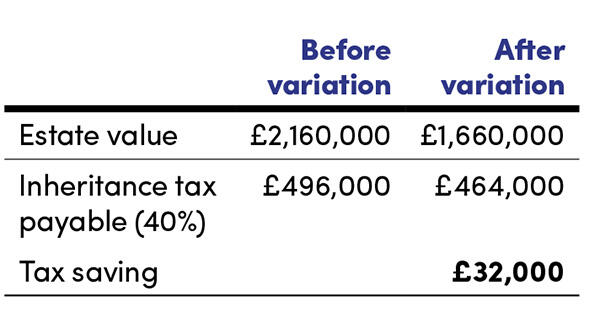
This example illustrates why deeds of variation should never be viewed simply as a mechanism for redirecting assets. The greatest benefit often comes from understanding how the variation affects reliefs, allowances and the taxation of surviving beneficiaries.
Other remedies may also be available. A disclaimer allows a beneficiary to refuse an inheritance, while rectification and construction proceedings may assist where a will fails to reflect the testator’s intentions or its meaning is uncertain.
Conclusion
Most will failures are not dramatic drafting disasters. They are often small imperfections, changes in circumstances or technical issues that only become visible after death. Their tax consequences, however, can be significant.
For tax advisers, the challenge is recognising when drafting, rather than value, is driving the outcome. Because inheritance tax follows legal effect rather than intention, a will that does not achieve the intended legal result may also produce an unexpected tax result. By the time estate accounts are being prepared, the best planning opportunity may already have passed.
© Getty images